Thursday, 29 May 2014

The pregnant tigress climbed out of the pool watched by 360 fascinated eyes! What a superb sight she was.


A retired Naval Commodore from Delhi, a chemical catalyst manufacturer who grows mangoes as a hobby, an anthropologist / advertising professional from Mumbai turned artist, two senior Nestle salesmen, an Air India pilot and a TIFR physicist couple met recently with 15 other like-minded people. What did this eclectic group have in common? They were all part of the BNHS trip to Tadoba to see tigers.

Frankly I was surprised to see other participants from across India – a couple from Pune, an elderly couple from Bangalore. But then, as the Zero Mile post shows, Nagpur is the centre of India, so it was to be expected. What was most striking about the group was they are avid BNHS fans and many have undertaken multiple trips with BNHS to other reserves – Bandhavgarh, Ladakh, Assam and Rajasthan being some of the favoured destinations. Even more surprising was some were actually coming for the 2nd or 3rd time to Tadoba.  They were knowledgeable about many bird and animal species and some carried fearsomely large cameras. I enjoyed the trip as it was a learning experience and eye opener for me, a first timer with BNHS. 

Tadoba Andhari Tiger Reserve is a Tiger reserve near Nagpur in Chandrapur district of Maharashtra. Tadoba forest reserve is predominantly  southern deciduous forest  with dense woodlands, around 87% of the protected area. However we were told that bamboo is now extremely common and is around 75% of the whole forest.  


I love seeing such signs as it recalls signs of camels, snow skis, deer and other animals seen around the world.


The name 'Tadoba' is the name of the God "Tadoba" or "Taru", loved by the tribals who live in the dense forests of the Tadoba and Andhari region. 

The River Andhari,  meandering through the forest, gives the name to the forest

Early morning or afternoon queue at the Moharli Gate. Around 25 to 30 jeeps. All gung ho to see the wildlife.


The road from Nagpur station to the MTDC resort is 168 kms, it took us nearly four hours excluding a pit stop at Jaam, 74 kms from Nagpur. The road from Jaam, near Tindurli, bypass near Shirao, becomes a narrow road and at times a dirt track as it passes through villages. Upto Tindurli, the road was a perfect well tarred highway. Then began the bone wrenching journey as the track was single lane most ways and often dirt track. There were patches of tarred road in between but how or why they were there made no sense to me. 
The best tea stall at Moharli Gate. You got tea, eggs, pawa etc at cheap rates. 

Be warned,the authorities charge Rs 200 per camera if it has a large lens. Definition of a large lens - it varies!!
This is the guide registration hut at Tadoba Gate. The beginning of the Tadoba reserve, 116 sq kms.

Total area of the Reserve is 625.4 square kms (241.5 sq mi). This includes Tadoba National Park, created in 1955 with an area of 116.55 square kms (45.00 sq mi) and Andhari Wildlife Sanctuary created in 1986 with an area of 508.85 square kms (196.47 sq mi). (Source - Wikipedia)

The Reserve also includes 32.51 square kms (12.55 sq mi) Protected Forest and 14.93 square kms (5.76 sq mi) 'Other areas'. Densely forested hills form the northern and western boundary of the Tiger Reserve. (Source - Wikipedia)

The roads inside the forest are mud track, tarred and marked so that all roads are one way direction only. these photos show the vegetation - at times bare, at timers full of bamboo trees. 
There are only TWO routes inside the reserve from Moharli Gate so after four safaris, you have  seen it all. 


The major drawback at Tadoba is that no cell phone works other than Reliance and there is no internet facility. Hence in case of any emergency at home, you are stuck. No one can get through unless you have Reliance. However, what was unusual and unexplainable was that just outside Moharli gate, for a span of 50 feet (no more), between the gate and the shop, there was cell connectivity from where I could touch base with my family daily just before or after safari.
.


This is the AIN Tree - also known as Crocodile Bark Tree due to the texture. its unusual and quite beautiful. 


Tadoba lake which acts as a buffer between the park's forest and the extensive farmland which extends up to Irai water reservoir. This lake is a perennial water source which offers good habitat for Muggar crocodiles to thrive. We saw one in the distance which must have been at least 12 ft long.

Tadoba lake sustains the Marsh Crocodile which were once common all over Maharashtra.

Other wetland areas within the reserve include the Kolsa lake and Andhari river. Tadoba reserve covers the Chimur Hills, and the Andhari sanctuary covers Moharli and Kolsa ranges


The Gond kings once ruled these forests in the vicinity of the Chimur hills.

These columns, made from natural material like brick,mud etc and gum from the gum tree (no cement) appear every 100 metres. A sign on them states the wildlife etc there - we did not stop to check if this is correct. 

In the old days, so goes the story, a rope was tied from tower to tower and a bell attached so that when the King went out in the country, the bell rope was pulled, the people were warned by the ringing bell and they stopped all illegal activities.
This  is the gum tree which changes colour in different seasons. A truly striking sight.


Gum is extracted by locals for different uses. There are five villages still within the restricted area practising farming etc.


Another magnificent specimen of a gum tree.

Aside from around 65 of the keystone species Bengal tiger, Tadoba Tiger Reserve is home to other mammals, including: 
Indian leopards, 
sloth bears, gaur, 
nilgai (largest deer species), dhole or wild dogs , 
striped hyena, 
small Indian Civet, 
jungle cats, sambar, 
spotted deer, barking deer, chital, and chausingha. 


Deer of various species at various locations in the reserve. The one above has just had a mud bath. 
A sambhar doe on high alert.


The young stags, some with velvet on their horns, looked very endearing but they were all on high alert seeing this motley crowd.
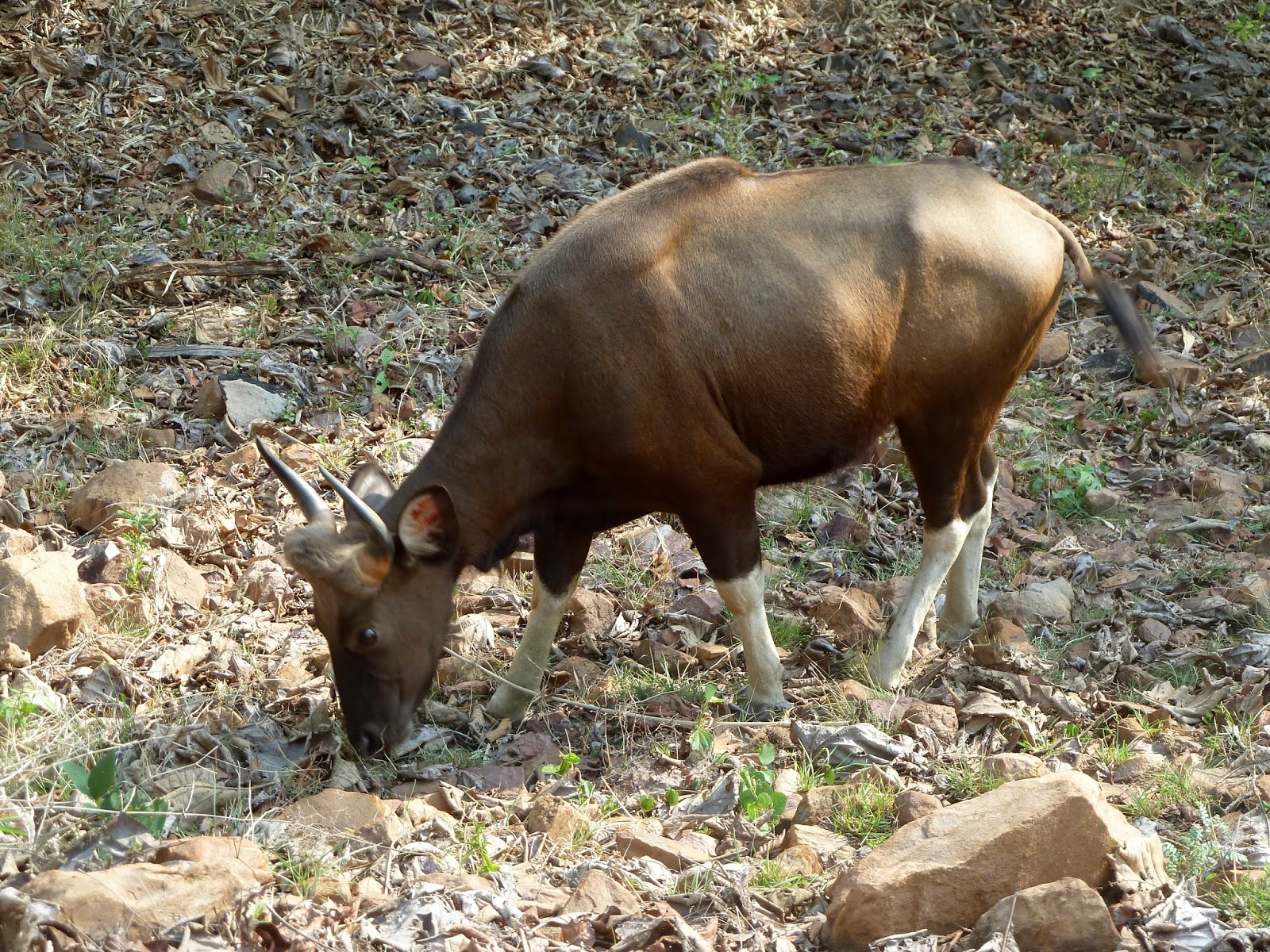
The Indian gaur. A fearsome beast. These are young females. We saw many of them, mainly young females in herds, the solitary male staying in the shadows. They came right onto the road and even crossed in front of us.


For over three hours on the second afternoon safari, I saw two tigers in front of me ---fascinating, but for the fact they were on the T Shirt of the rather large chap sitting in front of me in the jeep!!  We saw some deer and a night jar whose camouflage was superb. It looked like a stone rather than a bird. But no tigers. 


So, next day, I changed jeeps as I am superstitious of such omens! I was right, as the very next safari, we saw two real tigers, Gabbar and Choti Tara.


This is what it looked like when a tiger is sighted! Everybody queues up and silence goes for a toss."Dekho, dekho" .
The tigress Maya sleeping  under a tree.

At Gir, the jeeps keep in touch thru cell phones with rangers so they can see the lions. Here, there is no communication even though Reliance works. So, it’s all a hit and miss affair, and as it is on a one-way circuit throughout, you are bound to catch up with other jeeps. Hence the chance of seeing tigers is high, but not necessarily close up. Our sightings were around 200 metres away.
 Then hearing the noise of 30 jeeps with nearly 180 people around them, she woke to find out what all the cackle was about. 


Unable to bear this cacophony, she went for a swim and we caught her as she exited the water body. What a marvellous sight. Majestic.
 After she went, once again the wait began to see if any other animal came.

Cameras checked. Many folks seemed to have  large lens cameras.


Gabbar the tiger suddenly appeared from the bush.
 He spent far too much time in the water that we all left.

 Finally after the evening safari, at around 6.45 pm, the sun was about to set as we left for our MTDC rooms! 

The whole trip ended after our fifth outing. Basically very satisfying even though no tiger walked by me, unlike lions at Gir, but as I have had a real grown tiger’s head lying in my lap at Kanchanaburi’s Tiger Temple, I did not mind - i was happy; but that's another story for my travel blog.  The arrangements for return next day after breakfast were perfect and we reached Nagpur by lunch time. Saying goodbye to this group, where bonding takes place quickly due to the circumstances of being so close together, is always difficult but natural. One hopes that we shall meet each other again on safari or otherwise, thanks to BNHS’s organizational skills.


Text and photographs copyright of the author. No part of this article or photographs maybe transmitted or reproduced by any means, electronic, mechanical, photocopying or otherwise, without written permission. Do contact the author on email -- helpthesun@gmail.com

Wednesday, 21 May 2014

Images of Hong Kong


Maids are given one day off in a week. they meet at fixed locations. Each community to its own. Here we see the Indonesian community gathering together.  They come early by 9.00 am, find suitable spots and have a picnic and maybe gossip about their employers. They certainly carry food and shopping with them.

 Chinese restaurants are chaotic. How the food ever gets served is a six sigma exercise in itself. Very organised. Fast service. The walkers keep track of everything. The waiters dont speak much English but they are helpful. A 10% service charge is automatically added

 prawns and brocolli - my favourite dish.

This is bitter gourd (karela) and beans. Though a delicacy, i found it really bitter.


 This garoupa, served with sweet and sour sauce, lost its head, poor chap
 

Chinese Efficiency - changing table size depending upon the group.


Here is a Philipino earning his living. Sang really well; all the old Elvis numbers.


Ikea is a well known shop. What makes it unique is the way the Chinese use it. One would not see it anywhere else, possibly.

I saw couples cuddling together on the sofas, people relaxing and watching their mobile phones, two girls lying on a bed, two other girls playing a game sitting on the bunk beds. The best was two schoolboys - one using a wok cover as a shield and the other long tong or knife type instrument as a sword. They would not let me take a photo as they were wearing school uniform.


In parts of Hong Kong, the old life still prevails. Under a busy flyover, a shaman had set up shop. The custom seems to be that if you really hate someone, you go to her. She uses a shoe to beat a stone or any other thing and curses the person you hate!


Travelling by tram is fun. As a  senior citizen, you can travel for miles in one direction paying just HK $ 1.10, around INR 10.00. You get clear roads and the height gives you great sight seeing opportunities. Most tourists dont travel by tram as its too infra dig for them!
The buildings give a photographer sitting on the upper level of a tram great photo ops.


 In the old days, everybody had a personal chop. A small smooth piece of stone, depending upon your wealth, you had the stone. Onit carved in Mandarin originally, and now in modern Chinese, your name was drawn and then inscribed by the drill. I have had a chp for many years. i went to have it polished and cleaned. Incidentally, there is a book for English to Chinese names and to my lasting surprise, i found my surname in it, spelt exactly as I do it.


it requires great precision and proper alignment- he spent quite sometime getting it right.
here he is slowly going over the earlier engraved lines after applying white powder so that all the lines are clearly visible
 The malls are amazing. Hordes of people especially when there is a sale. Cant move. Mainly youngsters. Everybody shopping as if there is no tomorrow. This is the high end Pacific Plaza Mall atrium. Beautiful.
What strikes one is the youth - every where one sees mainly youngsters at work, including Immigration control at airport etc.

Finally, here are a few souls who have decided to do their own thing on Sunday and every day. Best wishes to them.


Text and photographs copyright of the author. No part of this article or photographs maybe transmitted or reproduced by any means, electronic, mechanical, photocopying or otherwise, without written permission. Do contact the author on email -- helpthesun@gmail.com

Wednesday, 7 May 2014

On a 57 ft narrow slow boat through Oxford

The preferred speed is 2 mph.The max is 6 mph.       
Your neighbours bawl out, Slow down!!


Total peace and greenery
There is a silence which takes getting used to. There is no noise – no police sirens, no traffic sounds, no city noise. You hear the occasional dog barking, the steady beat of your boat’s engine, and always the perfectly polite greeting of total strangers walking down the towpaths or from their own canal boats whilst you chug by in your 57 footer. At night, the silence is all powerful and you hear the minutest sounds on your own boat. You hear your breathing, the silent lapping of the water against your boat when the wind rises. Canal life is so different from city life and I wonder how residents adapt.. we took a full day to return to our ground reality.

We had a Bank holiday weekend and to avoid staying in London, we went on a long dreamt of pursuit….taking a canal holiday on one of the famous British Waterways Canals… the beauty of Oxford, the competitor of my alma mater,  was the best choice as the Oxford Canal has some really scenic sights.

The Blues - Light vs  Dark! 
The Oxford Canal was built by James Brindley in the 18thC. Many bridges and locks from that period still remain. The canal follows the contours of the land; giving delightful twists and turns across the gently rolling scenic countryside which in early May is full of flowers with hawthorn, apple and other trees in full bloom. The greenery comes in a multiplicity of varied shades; at one point, I counted over eight shades of green in one area alone.

Narrow boat taking a tight corner

Our Boat Company, College Cruisers, had nine boats varying in size and named after Oxford Colleges - striking in the dark Oxford Blue colours. Traditionally these boats were hired for week long cruises but with the trend in short weekend breaks, hiring Friday to early Monday is trendy at an affordable rate. The owner, wheelchair bound, doesn’t let his impediment hamper his running of the yard.. he maintains a strict vigilant control over staff, boats and visitors alike.

Imagine steering a Cruise liner or a Boeing – you realize what it must be like when you are at the other end of a 57 ft boat. Mike Stanley, a veteran of the canals, inducts us on the ‘Magdalen’- beginning with the cooking gas cylinders and water tank hose upfront. Then, through each of the rooms, beautifully furnished with maximum utilization of space, and finally at the rear, the bilge tanks and how to remove any blockage from the propeller shaft (thank God, as we had an occasion when the rope got stuck and Dilip had to put his hand into freezing water and unravel the rope from the propeller shaft!!)

Finally, the exciting bit of how to use the stick – forward / reverse, left / right. It’s simpler than learning how to drive a car AND you don’t need a license.

The first day saw the magnificent distance of eight miles being covered from Oxford to Thrupp – in all of 41/2  hours. We passed huddled groups of residential narrow boats which depending upon the weather look cheerful or gloomy; ranging from fancy well maintained boats to those of hippies with flower pots, baby carriages etc on the rooftops. We even saw one with a toilet bowl full of flowers perched on the roof. Basically life on the canal is an alternative lifestyle as it’s cheaper than land, more personal and definitely at a far slower pace. Winters can be bitterly cold as there is no built up area around to cut the wind which sweeps in. 

Waiting out turn to go through a lock

The Oxford canal has varying widths with specified places for narrow boats to turn. In our trip of 21.5 miles, there are only five turning points. Whatever the width, the canal is so designed to permit only one boat to go through at certain places. It creates a discipline and patience as you await your turn. Generally narrow boats are 6ft 10” wide. The length differs upon the accommodation. The draught is generally 2.5 ft and the depth of the canal is around 4 to 5 ft at the max. So, it’s a genteel way of travelling still practiced in England and becoming popular as you can travel long distances, albeit slowly.

Magdalen’ takes upto 8 pax - two single bunk beds converted to double if needed, a double bed, and a sitting room sofa converted to a double bed. Two bathrooms with running hot water + flush toilets, a fridge, a colour TV, central heating and a coal burning fire, a modern four ring gas range oven with all utensils required for cooking. 
You just brought your own food and towels. Everything else provided by the owner. And of course, be ready to keep a vigilant eye out to ensure you don't hit any other boat. 

A line of private boats moored 30 mins away from Oxford!

 We were amazed to learn that all bridges and locks are numbered. The map given to us showed each numbered bridge – fixed or lift type – and the locks. My first thought of a lift bridge was of how simple – strong enough to take a car yet light enough for a man to lift!! 

The first thought is, how is it possible as we are used to heavy large  bridges? in fact, its so simple. 

Lift Bridge – you pull the chain, sit on the bridge till the boat passes and release the chain!


All you do is pull on a chain, the bridge starts lifting. Its not difficult. Then you sit on the bridge until the boat passes through below you. Reverse order – you slowly get up, hold chain and gently let the bridge down. This was all created in the 18th C. Today, it would be computer generated with multiple cameras and laws to ensure you did not get hurt or blamed the local council !! Thank God for simplicity.

The Magdalen entering the Somerton Deep Lock – the deepest in UK. See the flowers

Check out the height and narrowness of the lock! 

Every so often, you went through under a bridge or a lift bridge. In all we went through 12 locks and 39 bridges of both types. The locks were a feat of engineering. We were going up river so we experienced the difference as the water level in each lock changed more and more until we reached Somerton Deep Lock, near Aynho village, a distance of 22.5 miles from Oxford. It is the deepest narrow beam chamber on the whole British canal system. As the Canal Companion puts it, the steerer’s eye view of things, when the lock is empty, is reminiscent of an elephant trap – it’s said to be 12 ft deep but felt like 18ft to me!

View from a lock!
Thrupp is very canal oriented – as it has a drawbridge at one end of the well maintained walkway with its small terrace of cottages fronting onto the canal - it is a village street. This area figured in the famous Inspector Morse series on TV. Part of the beauty of tying up by sunset, around 7 pm, is that you get to visit the pubs nearby and try out their local beer and food.

i think the major aspect of the whole trip was going thru the locks carefully without getting stuck or banging the sides of the slow boat along the bank. 

We had brought loads of food; my niece feared that as Jains, they would not get any food at pubs. But as we went for our evening libation, the ladies learnt that pubs offer excellent veg cuisine these days. The Rock of Gibraltar at Enslow, marker bridge # 215, serves excellent Mediterranean food courtesy the Manager from Corfu, Greece, with whom I reminisced about Gerald Durrell and his Strawberry House from My Family and other Animals!  

The Master Chef prepares before the trip!

When it came to it, the chefs could not decide what to cook!!We went to the pub. 
The section between Thrupp and Heyford is remarkably attractive. It drifts through the beautiful scenic landscape of the Cherwell Valley like something from a slow moving piano concerto, weaving romantic melodies with the harmony of birdsong which you hear everywhere. The rhythm and sound of the wind in the reed beds is unforgettable.

During the day, we would take turns steering. One of the ladies even created history by taking us into the mud bank, or should one say clay bank, three times. Essentially it’s a matter of concentration. We all found that if for a second we neglected to look straight as we steered, we would be all over the place as the river meanders and you just have to concentrate whilst driving!! We had to get the boat pulled once and the other times, we just expended energy pushing against the bank using the long poles and pushing the engine into reverse gear. It works but it’s exhausting.

The Magdalene passes through narrowly.
A mile or two south of Northbrook, past Enslow, there is a Roman Way which in the old days connected Cirencester with St Albans. South of this road we went through a dark emerald tunnel of overhanging trees, which have a primeval quality about them. The experience was unworldly.

We found throughout that the railway line is close to the canal. Trains rushed past at different times..they had passed us before we even knew it. Aynho station is closed but go past bridge 188 and see the old signaling yard. Aynho wharf is still attractive with its redbrick buildings now converted to a hire base and canal shop.


Two narrow boats in one lock 

The beauty of this whole journey was that at any time we could get friends to join us as the road access is close to the canal for meeting or car parking. The canals also have their own traditions and old world courtesy system including who overtakes, who goes first on the locks and at what speed you can travel on them. There is order and cleanliness everywhere – each tow path, each lock, each bridge is spotless. The refuse is collected at selected spots, never visible unlike the cities.

The finale was fortuitous. At 8.00 pm at night the ladies discovered that after cooking their nachos and tacos, they had run out of water..,. we had not filled up at Aynho fully as we were running late. What does one do? No option but go home as we needed water desperately and we had to give up the boat by 9.30 am the next day anyway.
 
Rohit's family came to check on his well being.

After 8.00 pm, canal travel is not permitted. We were around 45 minutes away from the boat yard. So, we quickly pulled up the hooks, reined in the ropes and went at 6 mph wherever there were no boats. It was tense as we were also beating the sunset and darkness. The canal has no lights so we kept the curtains open, all the internal tube lights on so as to see the banks clearly. What i call negative lighting ! Whenever we passed parked boats, we’d slow down to 2 mph. No ripples on the canal are permitted. Once or twice we got shouted at. Very bad form ! Finally at 8.35 pm, we reached the yard and tied up. We got water, had dinner and slept. We were lucky as at 4.30 am it started raining. Sorry, pouring down. By 7 am, it was still raining and it was cold. So we were saved the last day’s travel in rainy weather as we came in early and slept in the boat tied up at the yard. A blessing in disguise. A glorious end to a wonderful canal holiday. 

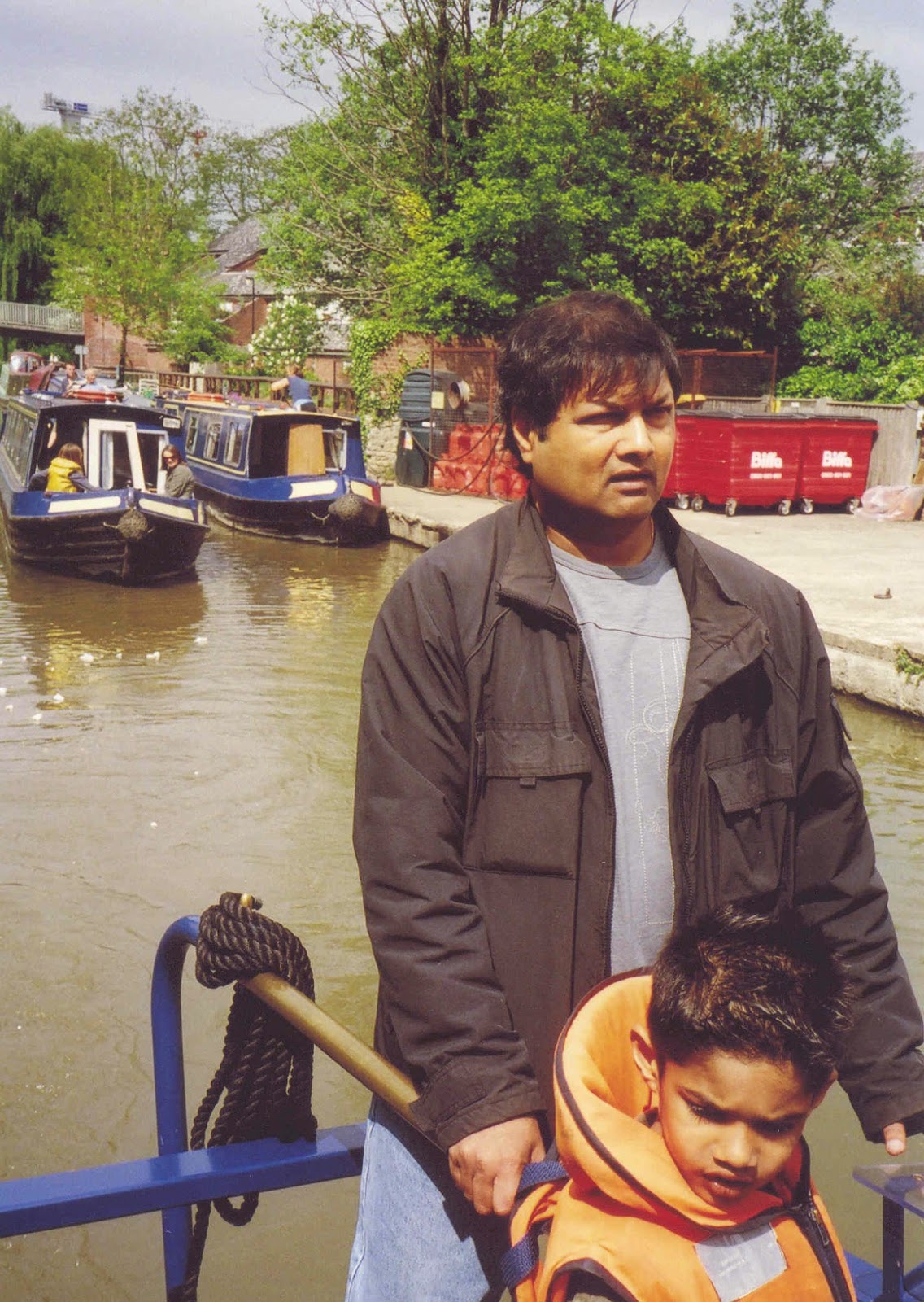
The author on his Canal Boat recce at Oxford.


Capt. Rohit Mehta and crew member


This article is dedicated to my nephew in law Rohit  Mehta, my niece Darshana and their son Shrey who courageously decided to accompany me on this holiday, not knowing where it would lead them, but they enjoyed it eventually. 


Text and photographs copyright of the author. No part of this article or photographs maybe transmitted or reproduced by any means, electronic, mechanical, photocopying or otherwise, without written permission. Do contact the author on email -- helpthesun@gmail.com