Tuesday, 6 December 2016

Thimpu - a photo essay on the city sights


I am not going to write about the city as you will find lots of info elsewhere. This is my blog on the places we saw and my impressions.


The first place that tourists can visit is the well known Memorial Chorten built by the Queen Mother in memory of her 44 year old son who died young.  


The place is crowded with Bhutanese who are generally very religious and extremely proud of and loyal to their Royal family. 

Hence, here we saw many people praying and circumnambulating around the Chorten.  It is not a unique place but it shows a side of Bhutanese culture and one reflects on the vagaries of life which can be unknown. 


Bhutan is a small country but it has some excellent museums. Each museum will have superb displays with well written panels detailing out the display. 

To add to the tourist’s education, Bhutanese museums also have a video being shown of the museum’s artefacts – here at the textile museum, there was superb documentary on the history of textiles in Bhutan and the different types of textiles made. 

Later in this blog, you will see some photos of textiles we saw at a weaver’s cooperative. Eastern Bhutan is well known for its many different weaving techniques using different materials.
Bhutan is renowned for its colourful postage stamps. At the postal museum, one sees the development of the use of stamps through recent history and every stamp is shown, some can be purchased. There was a postman renowned for his process in walking phenomenally long distances each day to fulfil his tasks. Coins are also shown here.  The guide in the museum was excellent and totally motivated in her job. 


About 5 kms from the city centre, amidst fields and nature, you come to see the High Court and the Parliament – I am told that the Parliament building houses various ministries too.    


The small building on right of flagpost is the Royal Palace


 The Simtokha dzong or fort is 5 kms away from town. We reached just in time as prayer ceremonies were going on – they would last for three days. The dzong was built by the Founder of Bhutan as there was a resident demon in this area, which is the main route between Central Bhutan and Paro. The dzong’s name – SIM = Demon; TO = Stone and KHA = on top; so the answer is To stand on top of demon. Built in 1629. In 1637 the Tibetan invaders came but were defeated. The central Tower is unique as it has 12 sides. The main building has 4 sides.
During the prayer ceremony, I saw three rows of monks facing each other, each row had around 11 monks.  A disciplinary monk walked between the rows checking what each novice monk was doing – singing properly and stopping the youngsters from fooling around. The head monk faced them in the central aisle. 300 monks live in this monastery. Prayers are unique as basically consist of reciting verses in deep guttural tones emanating from deep within the throat - very monotonous and reminds one of the Mongolian throat singing technique. All guides have to wear white scarves else they are not permitted. Permits had to be obtained for us as we found these are required at all dzongs. Register are filled by the guide detailing our personal info.  Around the main building of the dzong, are many carved statues in a line behind a glass case. Outside, one can see the huge Buddha statue in the distance.   


The vegetable market is amazing. Spotlessly clean. Huge area. Downstairs are local vegetables and upstairs the imported items. Lots of vegetables and fruits everywhere and no muck anywhere. I was shocked to see the cleanliness. 


We visited a weaver’s cooperative. Here we saw the famous KISHITHARA weaving technique. They have various items on sale – stoles, shawls, table runners, scarves, various small woven knick knacks etc. All expensive but really beautiful and worth buying. This was one of the few places where credit cards were accepted


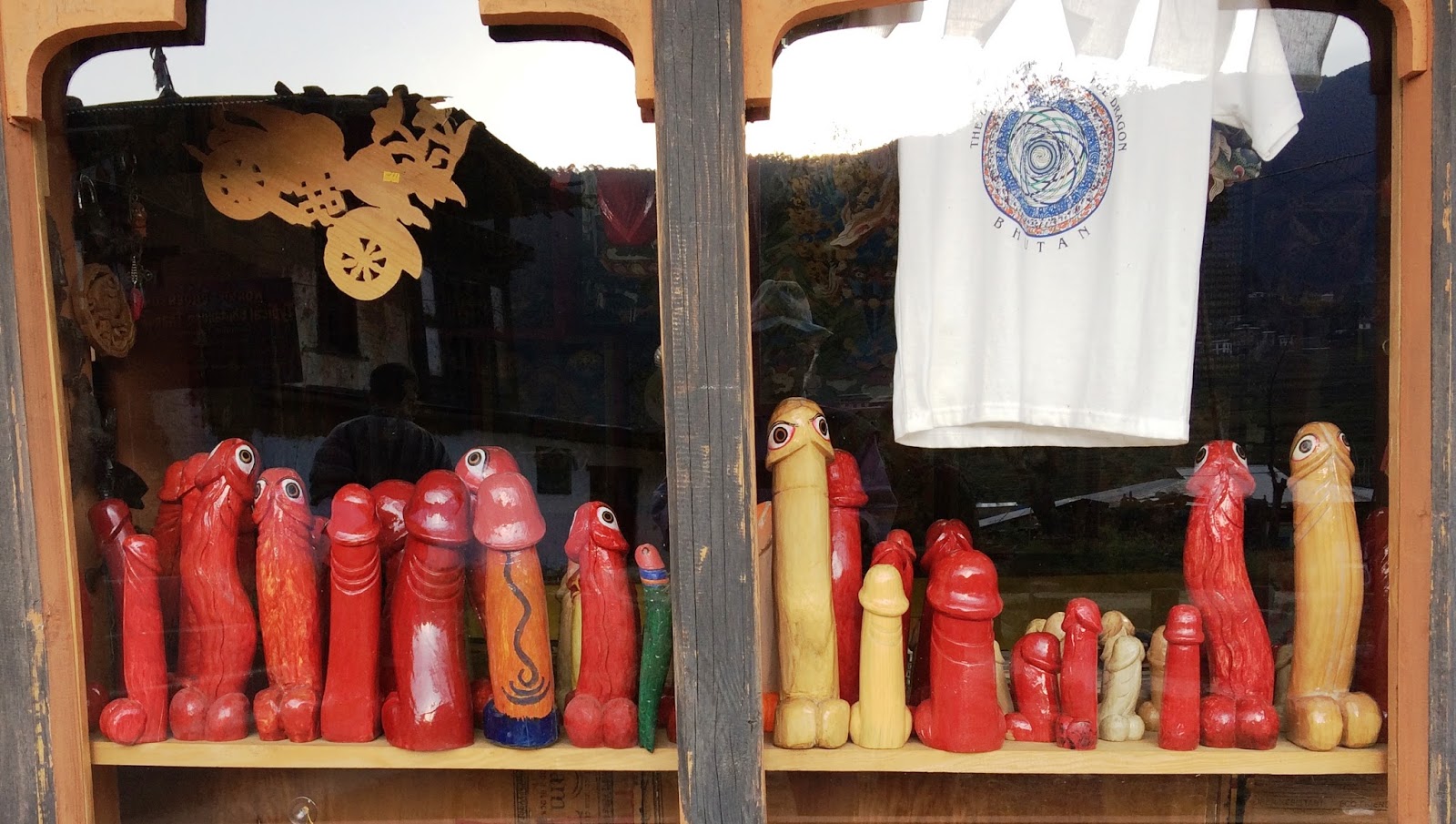
This shows a shop window featuring the Penis - symbol of fertility in bhutan. More later. 


Text and photographs copyright of the author. No part of this article or photographs maybe transmitted or reproduced by any means, electronic, mechanical, photocopying or otherwise, without written permission. Do contact the author on email -- helpthesun@gmail.com

Bhutan - some guidelines to enjoy the country.


Bhutan is a wonderful country - full of scenic value, warm hearted people and distances which take hours to reach! There are a few important Bhutanese rules to follow, apart from the ones the Govt tells you about before or on arrival. Also given at the end is the name and contact details of our excellent travel agent in Bhutan :
  1. Bhutan is a strictly cash economy. The concept of credit or debit cards as known in India or elsewhere does not exist. The only places taking credit cards are those where sales are high value – e.g. high end textile / retail shops or 5 + star hotels. Everywhere else it’s CASH, cash and Cash (note my variations on spelling to stress importance of cash currency). If you were like us, as we had limited cash, be warned, you will have a tough time. So travel to Bhutan with lots of cash. If using Indian credit or debit cards, inform your Bank of the destination abroad else the card will be barred / stopped after the first transaction. I do not know the current status after demonetization.
  2. Indians need to carry a passport or an election card to enter Bhutan. It’s advisable to carry a passport as with an election card, they issue a travel permit which the traveller needs to keep safely until departure when it’s collected back from you. Do not carry Xerox copies. I saw pax with Xerox election cards and they spent quite some time getting clearance.
  3. If you want a peaceful quiet holiday, without children running around, people screaming from one end to another, people often wearing their night gear to the dining room etc, do NOT stay in hotels which cater to Indian groups – especially Gujerati groups. Regrettably, I suppose because they come from the "interiors" of Gujerat like Porbandar, Surat, Bhavnagar, Rajkot etc and possibly may have never travelled abroad, they are unfamiliar with travel decorum or manners - they behave as if they are back home amongst their community. They have no respect for others and are noisy and believe that as they have money, they can behave any which way they want. They dont accept that they are at fault and become aggressive when you request them to make less noise. Be warned. We had to change a hotel room in Paro at 11.45 pm at night in 6 deg temp as we had noisy uncouth yuppie neighbours.
  4. Roads. Distances appear close by but do not forget that Bhutan is a mountainous country. You need to go up a mountain and then come down that mountain. There are no tunnels or direct routes. Not once, but many times, before reaching your destination. From Thimpu to Phubjikha was 134 kms. One would think that we could do this in may be 3 hours?? Excluding a break for lunch and a pit stop, it took us actual travel time of SIX hours: an average speed of 22.50 kmph. The roads are being re-constructed. You pass major road work; you have to wait at certain places where the work is going on. You have to go at walking speed at certain places as the drop down is many thousand feet. So, reaching your destination is an activity where you need patience. Here are the actual driving times for the places shown along with distances. No stops included.
    1. Thimpu to Phubjikha        134 kms       6 hours
    2. Phubjikha to Punakha      73 kms         3.50 hours
    3. Punakha to Paro    103 kms        3.00 hours
The worst stretch is the stretch going towards Punakha before you go towards Phubjikha. Don’t travel in anything less than a 4 x 4, if you can. Travel in Eastern Bhutan is more difficult as we were told the roads are worse. To go there, you require 2 to 3 days by car though distance is not much. So, plan the trip carefully.
5  Guide – for foreigners a guide and a driver are compulsory. For Indians, not so. However, if you want to appreciate the country and its intrinsic values, no amount of reading can beat the services of a good guide who is knowledgeable. We had a guide the first day who was appalling. We complained and had her changed. It’s important that you specify your requirements to the agent so that guides are booked accordingly. There is no point having an experienced guide on trekking when you want a guide more knowledgeable on Buddhism and textiles! Our second guide was outstanding. There is a custom to leave a gratuity / tip / appreciation for the guide and driver depending upon how happy you are with their services. This is totally voluntary but it is appreciated by them especially as they spend 24 hours at your service with you. It is considered an important part of their pay package.  
6   Food – Can get tedious at times. Most hotels and restaurants push their buffets as its fewer headaches for them, it’s more remunerative and all are catered at one shot. So, if you don’t want multiple items which mostly look the same at different meals but have different names, then demand a la carte. It’s better to have one decent item than so many which are tasteless. Also, Bhutanese eat a lot of chillies. So ask before placing the order. There is enough vegetarian food for visitors.
7   Museums – considering they are a small country, they have managed to create museums with outstanding documentary films shown at each venue, the exhibits are beautifully marked so as to be readable clearly and the displays are superb. I don’t think we saw one museum of poor calibre. Indian museologists need go only as far as Bhutan to learn how to create good museums for visitors to Indian museums.
8   Finally, especially for Indian tourists. Please treat hotel staff with respect. We saw many Indian tourists treating staff as if they were servants or worse: shouting and demanding services. They are not our servants. They work because they need the money and a career, just like most of us. Because we have money does not mean we treat them like scum. Its a sad reflection that we are our own worst enemies abroad by behaving so abysmally.


     We used Wind Horse Tours who had organised a 95 pax Rotary Group tour of which my nephew had been a member. Due to his reference, we used their services for our 10 nights / 11 day trip. We were extremely happy with their services. Our guide Sonam and driver Dawa were outstanding. 


They are a Bhutan based high profile Tour Company operating since 1998 setting high standards while keeping a competitive edge in pricing, product and quality services. We found their rates very good. Horse back trekking, deluxe camping, birdwatching, Buddhist Meditation Tour are exclusive products. Our guide was an expert on Buddhism and Bhutanese culture. 
They are a well established tour operator, employing 20 permanent staff and 15 registered tour guides. Selling both FIT and Group tours and focusing on sustainable and responsible tours. 


Text and photographs copyright of the author. No part of this article or photographs maybe transmitted or reproduced by any means, electronic, mechanical, photocopying or otherwise, without written permission. Do contact the author on email -- helpthesun@gmail.com

Thursday, 1 December 2016

Gangtey Valley Nature Trail, Bhutan - 4 kms of an incredible walk

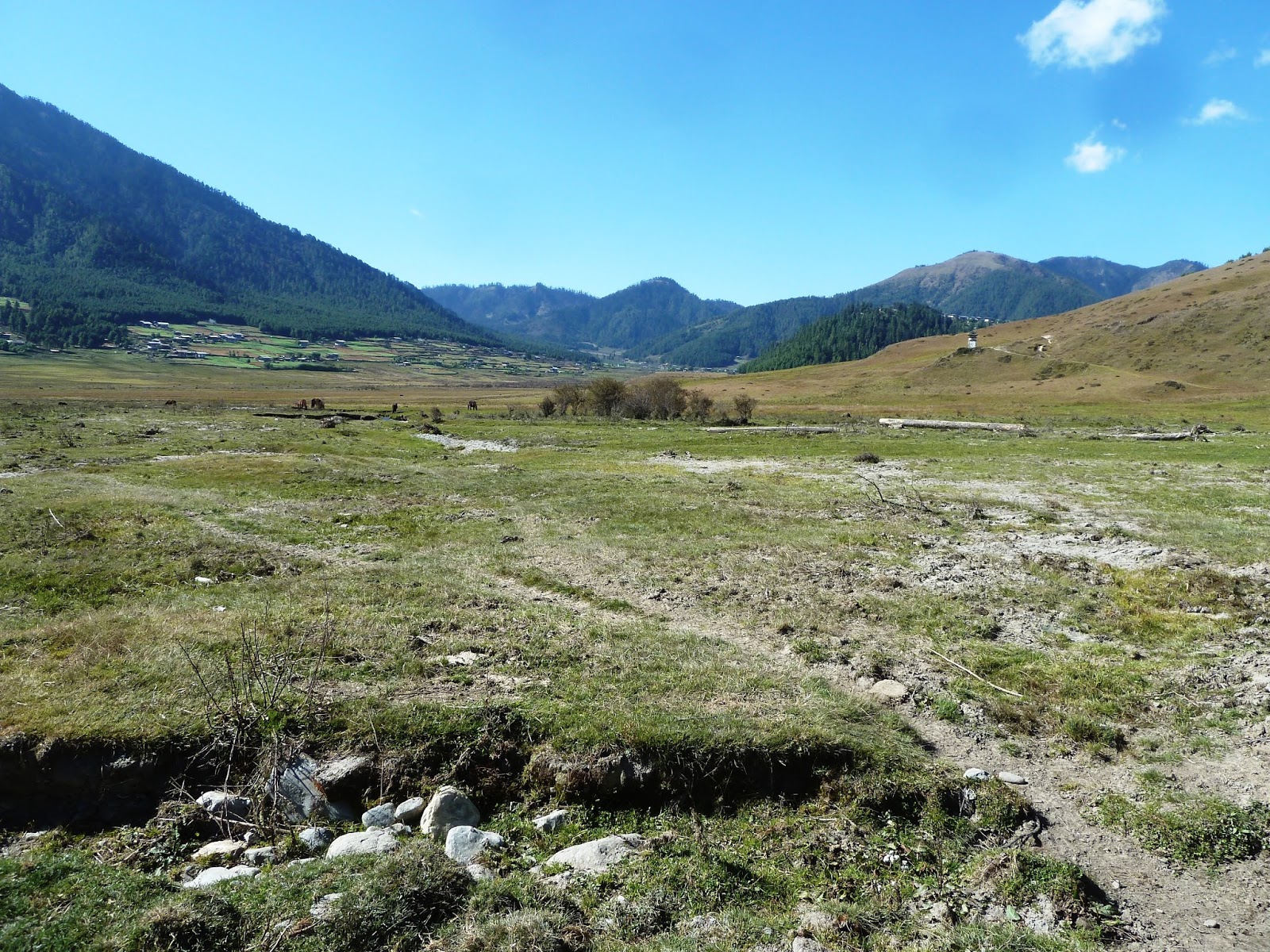
This is a great view of the scenery in this area 


We could call this blog - “Lost in happiness” as it was one of the most wonderful experiences I have had in my "young" life!!

We were at Gangtey, a few miles from Phubjikha, our base. We had just finished seeing the small monastery right at the end of the road and enjoying the beauty of its inner sanctum. Unfortunately, they do not allow photographs – in a way I can understand and appreciate that they don’t want their sanctum santorums to be commercialised.

I decided to walk a bit – so I left the family behind and walked down the single mud road of Gangtey. It was a nice sunny day, a bit overcast and not chilly. I passed a row of low houses on each side. In one a group of women were busy discussing matters. In another, chillies were being dried on the rooftop. Each building was similar in style. At the end of the short road, say 200 – 300 metres, a group of young Buddhist boys were lolling around on the grass verge and playing as all boys do. One asked my name and I replied in Bhutanese which surprised them!! We chatted in English for a while – they were fluent English speakers having learnt it at the monastery.


Right across the path, adjacent to a field, was a board promoting the Gangtey Nature Trail. The car arrived; the guide and my daughter stepped down. The guide suggested we walk as he knew my love for walking, not uphill walks. He confirmed that it was not strenuous and I would enjoy the walk. It should take around 40 mins.
So we began. The first 20 minutes were strictly down a slope. Carefully, to ensure we did not slip as sometimes we had to cross small streams by walking cross wooden logs or step on slippery stones, green with algae.

After the slope and the initial streams, the path, clearly marked, went straight along for quite a while – we went through sections of chir and black pine forests. Sonam, our guide, showed us the difference between the two: one has 5 spokes per leaf and the other 3 spokes; else same. We did not rush. 


Most of the time in this stretch, you could not get the long view of the valley as we were in the forest or clearing area, with minimal forward views.  At places, the path climbed gently but we did not feel any stress. I had my walking stick which was useful for balance when the path was muddy and at times I used it to leverage myself across difficult bits. 


We had not stopped for water so after a while, Sonam suggested a water halt at the Black Necked Crane bird hide.  I think it was exactly one hour after we began our hike, we stoppedThe path veered right down a slope and right until we came to the wooden platform, we did not realise the beauty beyond!!


Before us stretched the whole valley. Actually the part we could see. It is difficult to explain the view – the valley floor was different shades of dark and light brown as well as green. 

The valley sides merged with the mountainous slopes rising from the valley. I took photos which are shown here from one end to the other to try and explain the vast expanse in front of me. 

As we learnt later that evening, when we went for a drive, there is a large section of the valley which was not visible as it’s more in the shape of a boomerang. We were standing in front of the right half of the boomerang. There were no birds there. The silence was awesome. We sat for quite some time drinking in the serenity and having some water too.

We left feeling recharged. Its then that we actually saw how far we had to go!! My God, it appeared far far away. The slope was gentle. We passed some people selling joss sticks (agarbattis) out there in the wilderness!! 


After we had walked about 3 kms, we came to a stretch which passed through or close to a farm. The track was really mud and luckily it was dry. 

Then again through to the flat lands where we could in the far distance see our car parked. It was a total of nearly 1.40 hours for us to traverse this trail – we never rushed and we sat leisurely at the bird hide.


It was a super walk and something which every tourist should really do, keeping to Nature’s guidelines on silence etc, as then it awakens one’s senses to the beauty in front of us and lights our own inner beauty. 

Go ahead, if in Gangtey, don’t miss the trail. 


Text and photographs copyright of the author. No part of this article or photographs maybe transmitted or reproduced by any means, electronic, mechanical, photocopying or otherwise, without written permission. Do contact the author on email -- helpthesun@gmail.com