Wednesday, 28 February 2018

The road less travelled -----------to Nurata's Chashma Complex and Holy shrine


We left Samarkand for our yurt camp at 8.00am and then stopped after four hours at Nurata to see its famous shrine and Marinka fish!! The road through the semi arid desert stretched for miles.... totally boring scenery. The coach was new and comfortable, the driver good; so it was bearable. 
Nurata was founded as the ancient town Nur in 327 BC by Alexander the Great. The remains of his military fortress in the south of the town are still to be seen today and the water supply system that Alexander had installed is still partially used. The small town Nurata is located in the foothills of Nuratau Mountains, stretching out hundreds kilometres from Jizzakh and Barren Steppe to Navoi and Kyzylkum desert. It is the administrative and cultural centre of mountain area in Navoi region and is located almost 200 km from Samarkand.


The town is also famous as a Muslim pilgrimage place. Muhammad Narshakhi wrote about the history of Bukhara in 943 provides information about the settlement Nur. Narshakhi wrote” many people, who are buried there, have seen Prophet Muhammad”. During the 10th century pilgrims from Bukhara and other places came to the holy graves situated next to the town fortifications and mosques. 

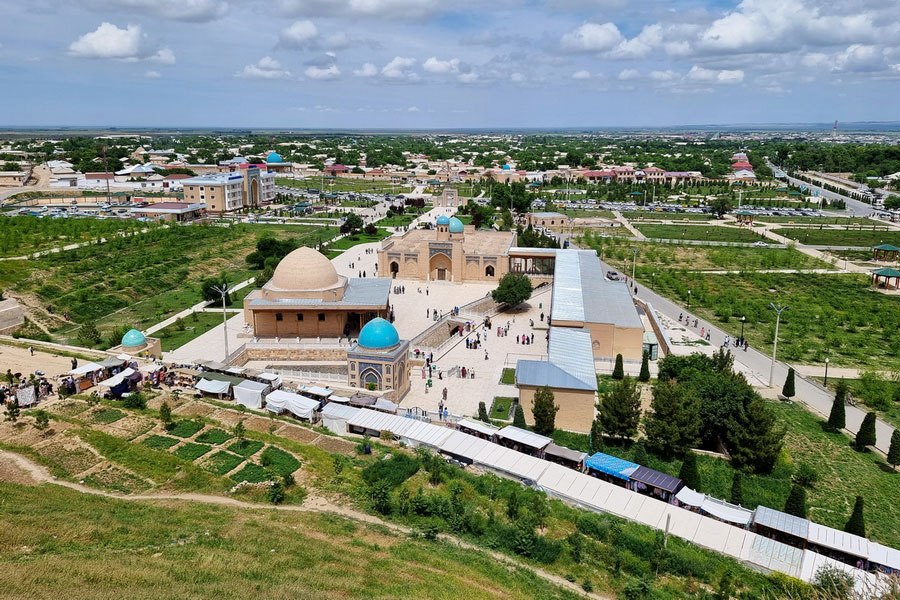
Chashma is a place of pilgrimage of believers and one of the most significant religious centres of Islam in the region. The complex of religious constructions “Chasma” (Tadjik word for spring) includes the spring, a well, mosque “Djuma” and khamom (bathhouse). The round Djuma mosque was constructed above the spring and has 40 columns. The dome is 16 meters in diameter is one of the largest in the Central Asia. On the south-east part of the complex is a Nur-ata cemetery with the burial place of the saintly person.

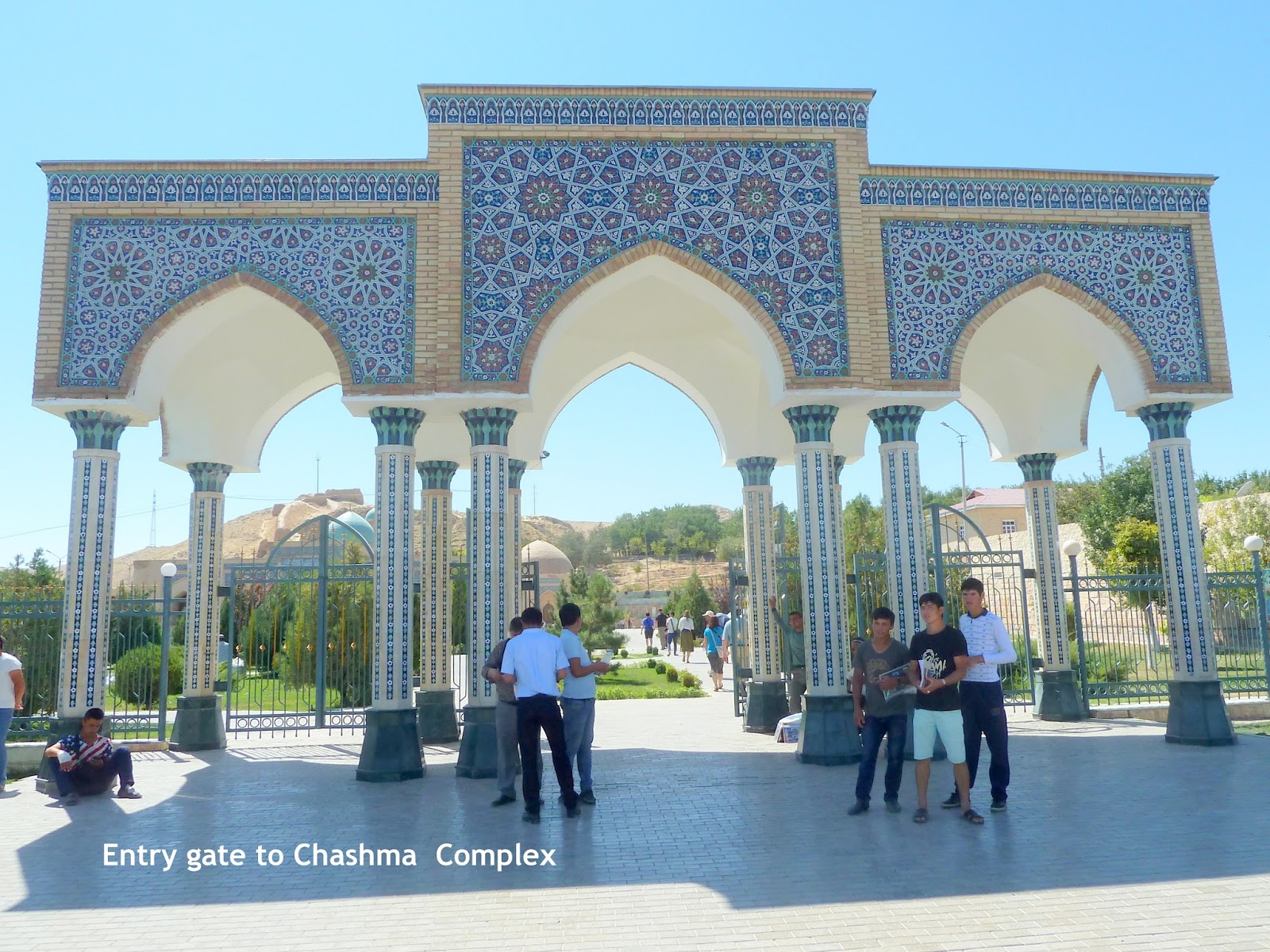
We entered the Chashma complex at high noon with the sun blazing down on us. Security was present but lax. The senior person, in the black round cap , above, supervised the older guy who was writing. Our tickets were checked and the details written down of each individual. What do they do with this data, I wonder? He looked at me rather suspiciously as I took photos of the guy writing our details. 
It is worth commenting on the technical / scientific data about this spring: the water temperature is always 19.5ยบ C. Water composition includes 15 microelements as well as gold, silver, bromide and iodine which impart unique healing properties to it. In addition the spring is the home for thousands of scale- less fish – Marinka. This fish as well as the spring is considered as sacred and people do not eat it.


The fortress consisted of several parts, with Shahristan (the inner town) around 500 sq metres in size, which was surrounded by a large wall and towers. The construction of a fortress at Nurata had a definite purpose, as the town was set in a strategic place at the border between an agricultural area and a wild steppe. This area is mentioned in several historical chronicles as an important strategic area convenient for gathering an army before attacking neighbouring lands and as a place of refuge for rebels and outcasts. The climb to the top of the ruined fortress was one I had to make to see for myself one of Alexander the Great’s fort and the view from above. 


The construction of Kariz, a unique underground water-pipeline system near Nurata, is also connected with the name of the Alexander the Great. Kariz is an ancient water-pipe laid from the source of the spring water to a place where it could be used. Its length could reach several kilometres. Interconnected wells that were dug out in several meters apart from each other, were used for the cleaning the pipeline system. Today the process of reviving these old pipeline systems is taking place. Parts of the pipeline systems near Nurata were restored and being used by local people.


We reached Ayederkul Lake, a completely man made water body created in 1996, at around 3.15 pm. Amazing sight right there is the desert. This huge lake. Horses were drinking at its far end. The majority of the group went into the water for a relaxing swim. 


I spent my time walking around and then we left for the yurt camp. Hope you read that travel blog: “A Yurt experience in the south-eastern Kyzylkum desert of Uzbekistan”. 


Text and photographs copyright of the author. No part of this article or photographs maybe transmitted or reproduced by any means, electronic, mechanical, photocopying or otherwise, without written permission. Do contact the author on email -- helpthesun@gmail.com

Murshidabad - The Palace with a 1,000 doors and the fabulous exhibits

In 1704, Murshid Quli Khan, the Diwan of Bengal under  Aurangzeb  transferred the capital from Dacca (now Dhaka  in Bangladesh), and renamed the city Murshidabad after his own name.                    In 1716, he attained the title of Nawab (ruler) of the  Subah  (province) of Bengal, and Murshidabad became his capital.         
The city is located on the eastern bank of the Bhagirathi, a distributary of the Ganges River. The name ‘Murshidabad’ comes from the place known as   “Muksudabad”  which was the capital of Bengal during Murshid Quli Khan’s rule. Before the advent of British, the city of Murshidabad was the capital of Bengal.                                                                                                           
It has a great significance in the Indian History as in 1757 the British defeated Siraj–ud–Daula in the Battle of Plassey, after which the entire nation was brought under the British Colonial Rule. Even after the conquest of Bengal by the British, Murshidabad remained for some time the seat of administration. The town still bears memories of Nawabs with mosques, tombs, and gardens, and retains such industries as carving in ivory, gold and silver embroidery and silk weaving.                                                                                  
             

Of historic interest are Nizamat Kila (the Fortress of the Nawabs) also known as the Hazaarduari Palace (Palace of a Thousand Doors), the Moti Jhil (Pearl Lake), the Muradbagh Palace and the Khushbagh Cemetery. Murshidabad today is a centre for agriculture, handicrafts and sericulture.


Early start. By 8.00 we were ready and left 8.30 in tongas for the mosque. We had 4 tongas and two electric ricks. 3 kms ride. Good fun as we went thru absolutely rural areas. 

 The Katra Masjid (also known as Katra Mosque) is a mosque and the tomb of Nawab Murshid Quli Khan built between 1723 and 1724. It is located in the north eastern side of the city. Its importance lies not only as a great centre of Islamic learning but also for the tomb of Murshid Quli Khan, who is buried under the entrance staircase. The most striking feature is the two large corner towers having loopholes for musketry. 


 Built by the first Nawab. The central area very large can take up to 10,000 people. Upfront was the place for the Nawab.


Surprisingly no water tank was discovered so arises question as to how did people do ablutions before prayers.


There are two sets of rings in the wall. One set for the wet khas and the other for tent like covering which was tied down at the far end to rings in a line nearer the entrance side. Essential in 45 deg summer heat.   


 In the large square, the black tiles are so arranged that there is a clear delineation of space per person identified by the mat size marked out throughout the square. so each individual had his area for praying.


Domes are half moon shaped. Inverted lotus on top shows Hindu influence.   

Central path from gate to the far opp side was built from Rajmahal hills’ stones of black basalt. 
Further in, three domes of which the central dome fell in due to earthquake in 1896. In fact from the other side, towards the exit, the far side large exterior wall curves outward and shows the wall leaning slightly downwards.


Hazaarduari Palace is in the campus of Kila Nizamat of Murshidabad. It was built by architect Duncan Macleod, under the reign of Nawab Nazim Humayun Jah of Bengal, Bihar and Orissa (1824–1838). The foundation stone of the palace was laid on August 9, 1829, and that very day the construction work was started. William Cavendish was then Governor-General. 

All of us had to deposit cameras and electronic items outside so the ship's crew had two large bags and two guys who looked after the stuff whilst we were inside. Palace has 1,000 doors of which many (900?) are false. The museum has excellent captions in two languages and in Braille against each spotlessly clean exhibit. It beats the Prince of Wales museum in Mumbai in this respect. Each exhibit has good lighting. Those in the corridors are at the right height. Apparently the chandelier was not clean but I did not notice that. The collection in the palace rooms feature arms, paintings by French and Italian artists, porcelain and stucco objets d’art, rare books and firmans, old maps, land revenue records, elephant ivory items, howdahs and palanquins of silver and ivory, miscellanea from glass, and other items. There is a throne room, a meeting room, a large billiards room with two outsize tables and no green baize. 
Spread over a massive area of 41 acres, the magnificence of Hazaarduari Palace is awesome. The name roughly translates to 'a thousand doors' as this palace is embellished with a thousand ornamental gateways. The construction style of the palace is an amalgam of Italian and Greek architecture styles and is a great example of Murshidabad's rich cultural heritage. The palace is located on the eastern banks of the Bhagirathi River within an enclosure called the Kila Nizamat. The perimeter of the palace also houses the Nizamat Imambara, Wasif Manzil, Bacchawali Tope and the Murshidabad Clock Tower.  In its earlier days, the palace was a regal mansion, but now it has been converted into a museum. Ranging from Siraj-ud-Daula's prized swords to the vintage cars owned by the Nawabs, it has amassed the life and times of Mir Jafar's dynasty.


This notice outside the Museum is priceless in its own right. Read it carefully. 


After we saw the palace, we exited, collected our electronics and walked about 250 metres along the river path to the ship which sailed at 11.15 am, as scheduled. 


Lunch was excellent and then slept for a while. Always the thought that I will miss an interesting sight.


Text and photographs copyright of the author. No part of this article or photographs maybe transmitted or reproduced by any means, electronic, mechanical, photocopying or otherwise, without written permission. Do contact the author on email -- helpthesun@gmail.com

Matiari - You hear the sound of hammer on metal from afar ! A village of metalsmiths


Matiari, a village where people are 24 hrs at work. It can be called a Brass working village. The history of the village dates back 100 years back. The senior leaders of the village went to Calcutta to work in the brass utensils making factories but as they grew old and less efficient, they were sent back to their native place.

As the villagers had nothing to do for their livelihood; they started making the brass utensils at home. And that is how the tradition is going on and today it has become main source of income for the people living in Matiari. 


We had tied up at the jetty late in the evening and the excursion to see the metal workers was for early morning: 7.00 am!! This meant getting up much earlier so as to be ready on time. Ghastly thought. Early morning, I could hear from my cabin’s open windows the sound of metal being beaten. It’s a sound one does not expect at that hour. ... the constant thump of a hammer on metal.During our morning walk, we came across the locals returning from the fishing trip. Fresh fish in metal buckets tied to the cycles were going to market. A place which we visited later on.


We had two guides who as it later turned out were artisans working in the village. One of them was gifted engraver. 
Every household is involved in the business of metal in some way or another. Each unit makes one item: whether it’s rolling, pressing, design or polishing. There is no other industry. Every house does some part of the process. So, we left at 7.00 am for a sightseeing tour of the village. Early as our guide claimed that people work here at night time when it’s cooler. The fires are hot and daytime becomes unbearable. There was no particular order of our visits to the workshops. 

We saw the thalis being made, then saw the whole process -- basically, scrap being fed into furnace, Metal ingot weighs 500 gms. These are then put into furnace and repeatedly rolled and heated until you get plates. Making plates, they get 15 / kg for a bundle which is between 30-35 kgs. These are then sent to finishers who remove rough edges. Polishers then create the finished article. We saw large biryani handis being made along with other utensils. Most of them work in semi darkness. They are really poor in this town. Saw only two houses of one storey with AC. 


We then went to two shops. The locals with us who were answering our questions turned out to work at these shops. One of them was an engraver. I bought a copper brass cup and then thought he could engrave my grand daughter’s name on it. This he did. 


The group were surprised with the engravers speed and delicate hand. I even asked for a rose along the name. So I paid 300 for the cup and gave 100 each to the owner and engraver for the engraving. Total 500. 
At the next shop I bought a small Ganesh for 300 as the group did not buy much here. We walked back and were on board by 10.00 for our onward journey.
I went back to my cabin and tried to sleep having got up at 5.30 am. Luckily, I woke just as we passed the area of the Battle of Plassey. I came to know about it afterwards at lunchtime! 


Text and photographs copyright of the author. No part of this article or photographs maybe transmitted or reproduced by any means, electronic, mechanical, photocopying or otherwise, without written permission. Do contact the author on email -- helpthesun@gmail.com