Our new friend Moh’d Adel Omar, noted Egyptologist and guide, began the day by taking us to Saqqara. Like us, you may have never heard of it; BUT it has the distinction of being the very first pyramid ever built, even before the Giza pyramids in Cairo. Getting there meant a ride thru villages on dusty roads, camels, carts and farming communities en route. A bit like travelling in northwest India, without the colour. Saqqara is around 20 kms on the same limestone plateau as Giza.


 Saqqara’s name is derived from the name of the mortuary deity “sokar”. Some scholars believe that the name Saqqara is not derived from Sokar, but from a local Berber tribe "Beni Saqqar".
 The area is huge – 22 kms N to S and 7 kms E to W. it is worth noting that Saqqara was built well before the stone pyramids of Giza and that it is from 2650 BC. That’s 4,550 years ago. Pyramid building in Egypt first began here. Its mind boggling to think that Saqqara’s pyramid with a well planned layout, the stonework looking like wood work, the incredible paintings / etchings etc were all created so many years ago. Imagine the craftsmanship and how difficult it must have been without modern tools. Due credit needs to be given to a Frenchman who gave 75 years of his life to Saqqara: an archaeologist Jean Philippe Lauer. He undertook modern restoration techniques and in his honour, the Egyptian Antiquities Dept has a special plaque as well as a room in the museum dedicated to his life work.


 The 3rd Dynasty saw the beginning of this Step or rectangular pyramid built by Djoser, its 1st king. His name comes from ‘Geser’ or ‘Sacred’; his other name was Netjerykhet. Sixteen kings built pyramids here which are still being excavated. High officials added private funeral monuments. It remained an important complex for non-royal burials and cult ceremonies for more than 3,000 years, well into Ptolemaic and Roman times. Its a World Heritage Site since 1979.
 By the main road is a ticket window. Facing it is a large board which details out the 12 main tombs and monuments here. Difficult to read as the sun casts shadows on the raised letters. We go up a winding road and then see two pyramids in the distance.


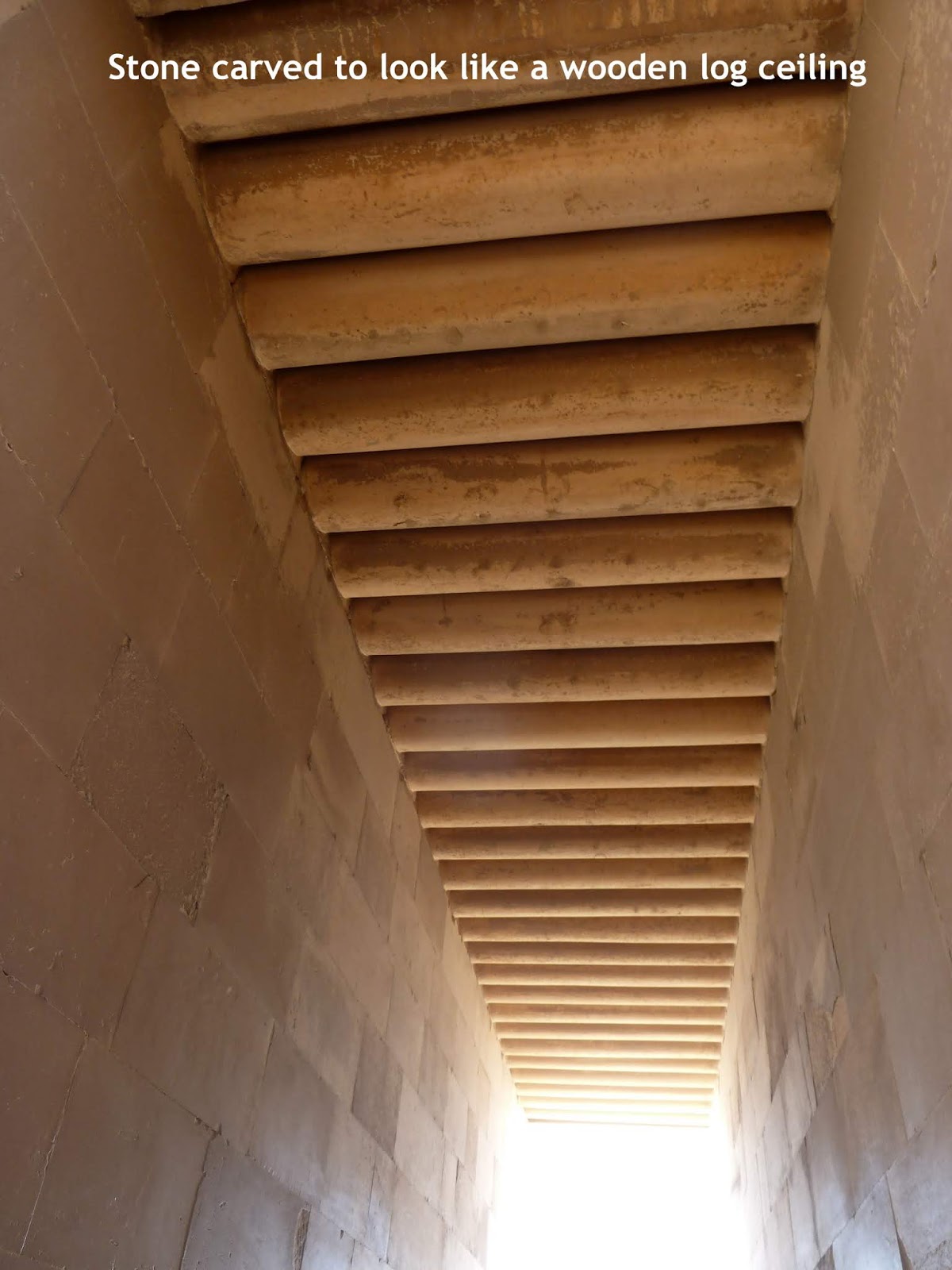 Further away is the Step Pyramid. The pyramid complex is surrounded by a huge wall of limestone. Between the bastions of the wall are 14 closed dummy doors. To enter the complex, you face a large square structure with a smallish door. Chinese with their long camera sticks (they have no concern for other tourists) have to be dodged or blocked so that you can progress forward. Adel now is in his element. He makes us look around and up and tell him what we see. We are entering a corridor with round stone logs above us. Adel gleefully points out what we have missed – these stones represent wooden palm logs in ceilings; there is even a stone hinge representing wood hinges. There is no real door. There are huge dummy doors with hinges in the open position.
  We enter a colonnade of many columns. A small wall joins each column. Apparently the inspiration was from bunches of reeds tied together with the heads fanning outwards. Scholars speculate that the columns symbolised the provinces of Egypt. Deities may have been between each column. One particular aspect which is fascinating is that there are traces of red paint in many columns – as if representing wooden columns.
 We come through to a huge – massive - courtyard relatively busy with tourists. They are in groups – some facing the stone pyramid in front of us, some in the far distance going towards some buildings and some to our left seeing some structures there. I stare at this massive pyramid. It’s so different from Giza. There are two workers way up on the left side. Due to barricades blocking the major repairs, no tourists are allowed near the scaffolding which covers one wall.
The 3 columns are part of a Royal Pavilion or Heb Sed Temple in which apparently a statue of the royal soul was kept. Adjacent to it is the Heb Sed courtyard. We see remains of chapels. There are two buildings called the North and South House. Here we see something unique. Facing the door is graffiti in hieratic script, a cursive writing of hieroglyphics !! Apparently written by Thebes’s tourists in praise of Djoser. Earliest records of tourists who came to admire monuments which were already 1,000 years old then.

 The form of the pyramid can be explained as a development of the large mastabas (mud-brick tombs) of the First and Second Dynasties; the six steps, each smaller than the one below, having been produced by the addition to the original mastaba of successive new layers of masonry, accompanied by the enlargement of the lower stages. The Step Pyramid stands 60 meters high and is built of locally quarried clay sandstone of poor quality. The chambers and passages in the interior of the pyramid served partly for the burial of close relatives of the King (in particular those of his sons who died in childhood) and partly for storing grave-goods for the use of the dead.


In 2011 at the dog catacomb in Saqqara necropolis, Salima Ikram and a Cardiff University team uncovered almost eight million animal mummies at the burial site. It is thought that the mummified animals, half of which were birds and many dogs as well, were intended to pass on the prayers of their owners to their deities. In July 2018, an extremely rare gilded burial mask was found. The last time a similar mask was found was in 1939. In November 2018, seven ancient Egyptian tombs were located at the ancient necropolis of Saqqara with a collection of scarab and cat mummies, dating back to the Fifth and Sixth Dynasties. In mid-December 2018 the Egyptian government announced the discovery at Saqqara of a previously unknown 4,400-year-old tomb, containing paintings and more than fifty sculptures. It belongs to Wahtye, a high-ranking priest who served under King Neferirkare Kakai during the Fifth Dynasty. The tomb also contains five shafts that may lead to a sarcophagus below.


 The pyramid of the last king 5th Dynasty, Unas is smallest and once the finest. He was the first king to adorn the chambers in his pyramid with texts. The walls of the central chamber and the tomb chamber are covered with inscriptions, the "Pyramid Texts," the oldest known Egyptian religious texts, relating to the life after death in which the incised hieroglyphs are filled in with blue pigment. The inner walls are decorated with scenes in bas relief : hunting, boating, animals of various types, battle scenes etc. The complex of Unas pyramid had a processional ramp, funerary temple and a pyramid valley temple.
 |
| Outside the Complex is The Imhotep Museum. The idea was to have a dedicated space for the discoveries of this area only. Conceived in 1990, launched in 1997, it’s a compact beautiful museum with select exquisite exhibits. A small theatre features a 10 minute film show on the whole complex. There is also a full scale model of the pyramid and funerary complex. The museum has a large corridor with two halls and four halls on the two sides of the corridor.
there are many good exhibits – the first known medical / surgical instruments, The Mummy (which looks as freshly painted as yesterday!), displays of beautiful alabaster jars and how carving of stone vessels was undertaken, how locals drew the human form, and of course Imhotep’s titles. But one of the most beautiful is a set of blue green faience tiles reconstructed to show us how the walls of these chambers looked in days past.


 We spent a considerable amount of time seeing Saqqara but even then we saw only the major well known exhibits. There are many pyramids and tombs we could have seen but then, time was short and we had many more things to see in Cairo. One thing is certain – Saqqara is to my mind, far more attractive a place than the Giza pyramids. It has far more to offer. Don’t miss if you are in Cairo and ensure you take a good guide with you from whom you can learn the history of those bygone days.


DEDICATION :

 This article is dedicated to 1) Dr Amr Hassanein introduced to us by a mutual friend. He extended to us a very warm welcome without ever knowing us. His office arranged for the car and guide. We are deeply appreciative of his kind hospitality.
 2) Mr Moh'd Adel Omar, Egyptologist and Guide Extraordinaire. Moh'd is an amazing person - a fount of knowledge, humour and elan. His love for his country and his job as a guide enlarged our knowledge of the country and we missed him throughout the rest of our tour as no other guide matched the high levels he had set!
Thank you both.
Text and photographs copyright of the author. No part of this article or photographs maybe transmitted or reproduced by any means, electronic, mechanical, photocopying or otherwise, without written permission. Do contact the author on email -- helpthesun@gmail.com


