Thursday, 21 May 2020

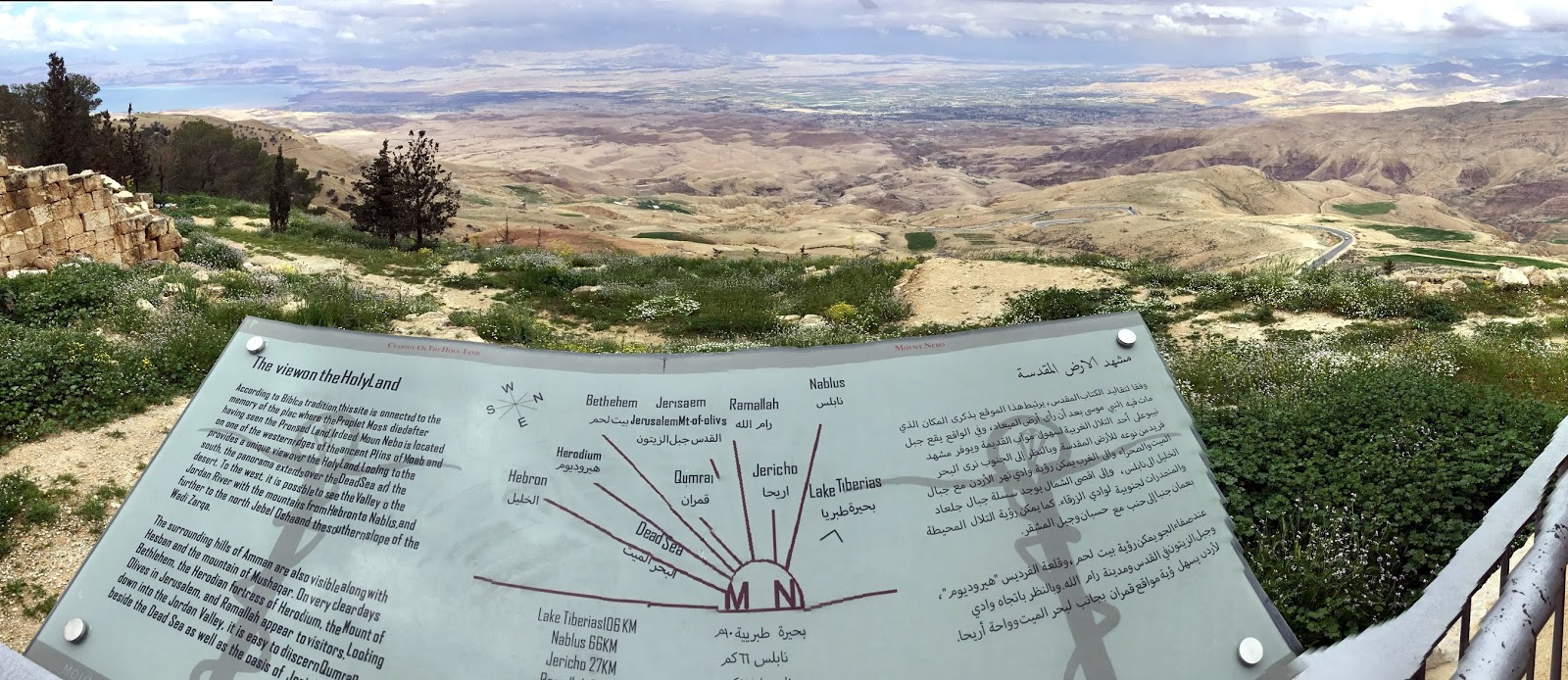
Mount Nebo - a unique view of the Holy Land - from Dead Sea to Nablus and beyond. Moses died here after seeing it.


We arrived here from Madaba and were en route to Petra. Arriving at the entry, there is a  long path leading right up to the church and the railings from where you get one of the most fantastic views of the Holy Land. It was a cold cloudy windy day and we had about an hour or two to see the site. 


Starting with the view right around outside, you walk around the whole railing area so that you get a view of the lands beyond. The stone and metal boards detail out the names of the cities and their directions. To think that this area covers different countries in a small radius who have multiple religions and many faiths amongst them too.  There was a small group of German tourists who huddled together in a cluster and sang some hymns. Very soothing to hear them in that cold bracing air. 


I went later to the museum which is small but extremely well designed with captions. I acknowledge with gratitude their information which I photographed so that my blog readers get an excellent idea of what it contains.  


Finally into the church, up a ramp. Amazing. The whole area had been beautifully developed and preserved as they obviously get considerable revenue from tourism. The frescoes and mosaic flooring are preserved carefully behind glass and one can really appreciate them. I think though the place is so small, it was a highlight of our trip and more enjoyable for me than visiting Petra which was to follow the next day.
If you go to Jordan, don’t miss this unique destination... Mt Nebo. 

Following data from Wikipedia which gives the reader a better idea of the archaeology and religious significance.  

Quote
Religious significance
According to the final chapter of the Book of Deuteronomy, Moses ascended Mount Nebo to view the Land of Canaan, which God had said he would not enter; he died in Moab.
According to Christian tradition, Moses was buried on the mountain, although his place of burial is not specified (Deuteronomy 34:6). Some Islamic traditions also stated the same, although there is a grave of Moses located at Maqam El-Nabi Musa, 11 km (6.8 mi) south of Jericho and 20 km (12 mi) east of Jerusalem in the Judean wilderness. Scholars continue to dispute whether the mountain currently known as Nebo is the same as the mountain referred to in Deuteronomy. According to 2 Maccabees (2:4–7), the prophet Jeremiah hid the tabernacle and the Ark of the Covenant in a cave there.
On 20 March 2000, Pope John Paul II visited the site during his pilgrimage to the Holy Land.[  During his visit he planted an olive tree beside the Byzantine chapel as a symbol of peace. Pope Benedict XVI visited the site in 2009, gave a speech, and looked out from the top of the mountain in the direction of Jerusalem.
A serpentine cross sculpture (the Brazen Serpent Monument) atop Mount Nebo was created by Italian artist Giovanni Fantoni. It is symbolic of the bronze serpent created by Moses in the wilderness (Numbers 21:4–9) and the cross upon which Jesus was crucified (John 3:14). 
Archaeology
Systematic exploration begun by Sylvester J. Saller O.F.M. were continued in 1933 by Jerome Mihaic of the Studium Biblicum Franciscanum. On the highest point of the mountain, Syagha, the remains of a Byzantine church and monastery were discovered in 1933. The church was first constructed in the second half of the 4th century to commemorate the place of Moses' death. The church design follows a typical basilica pattern. It was enlarged in the late fifth century AD and rebuilt in AD 597. The church is first mentioned in an account of a pilgrimage made by a lady Aetheria in AD 394. Six tombs have been found hollowed from the natural rock beneath the mosaic-covered floor of the church.
Bellarmino Bagatti worked on the site in 1935. Virgilio Canio Corbo later excavated the interior of the basilica. In 1963, he was put in charge of restoring the original pavements for exhibition. In the modern chapel presbytery, built to protect the site and provide worship space, remnants of mosaic floors from different periods can be seen. The earliest of these is a panel with a braided cross presently placed on the east end of the south wall.
The Moses Memorial that houses the Byzantine mosaics was closed for renovation from 2007 to 2016. It reopened on 15 October 2016.
Unquote

Text and photographs copyright of the author. No part of this article or photographs maybe transmitted or reproduced by any means, electronic, mechanical, photocopying or otherwise, without written permission. Do contact the author on email -- helpthesun@gmail.com   

Little Petra - the Cold Canyon, a different experience to Petra, the Rose City.

We still had to see Little Petra whose existence we came to know about only when planning our trip. The tour operator insisted that it was a waste of time but seeing as we were there, we insisted on going. So, after lunch and a brief rest, off we went to see yet another archaeological site (don’t forget that by now we had already toured most of the important sights of Egypt for the previous 13 days; Amman for 2 days, Madaba and Nebo the previous day before coming to Petra). To say that by now I had a surfeit would be pretty accurate. Anyway, Little Petra it was. 

Little Petra is arid, mountainous and basically a desert area about 1,000 metres above sea level. On its east the Arabian Desert, in the west the rugged terrain descends into the Jordan Rift Valley. There are areas around the Dead Sea as low as 400 metres below sea level. We climbed up from our hotel and came onto the local road that leaves Wadi Musa and then goes around the edge of the mountains around Petra itself through a Bedouin village named Umm Sayhoun. Then you see a short road leading to the small unpaved parking lot for Little Petra. 
When we arrived mid afternoon, there were around six cars, two mini buses and a few donkeys. I was the leader and sole member of the expeditionary force to see Little Petra as the others had bowed out due to the driver’s disparaging remarks about the site. In hind sight, I agree with him. But still, being there meant it had to be seen.  
Little Petra is known as Siq al-Barid literally "the cold canyon."  “Like Petra, it is a Nabataean site, with buildings carved into the walls of the sandstone canyons. It is much smaller - consisting of three wider open areas connected by a 450-metre canyon. While the purpose of some of the buildings is not clear, archaeologists believe that the whole complex was a suburb of Petra meant to house visiting traders on the Silk Road. After the decline of the Nabataeans, it fell vacant, used only by Bedouin nomads, for centuries. Along with neighbouring Beidha,
Little Petra was excavated in the later 20th century by Diana Kirkbride and Brian Byrd”.
“Located along the main avenue in Little Petra (Siq al-Barid), the Painted Biclinium is a rock-cut biclinium, or dining room, with well preserved wall paintings. In addition to offering the most abundant variety of figural painting from the Nabataean period, the frescoes of the Painted Biclinium may offer clues into the vegetation under cultivation in the area around Siq al-Barid. In addition, the paintings are proof of the importance of Dionysiac religious cult in Nabataea. The Painted Biclinium comprises rock-cut stairs leading up from the floor of the Siq al-Barid, terminating at a platform hewn from the wall of the narrow wadi. The platform stands before the main entrance to the Biclinium, which leads to two chambers, one of which leads into the other. The first chamber is larger than the second, and is rectangular in shape with two benches carved out of the rock on either side of the door. The smaller, interior chamber is vaulted, and has a higher floor level than the first room. The monument parallels other feasting structures from both Little Petra and its environs, some of which are directly associated with nearby tombs and the veneration of ancestor cult, while other examples are not associated with tombs and are instead interpreted as spaces for religious feasting”.
The Painted Biclinium is a rock-cut biclinium or dining room 
“This biclinium, in one of the caves was discovered to have surviving interior art depicting grapes, vines and putti in great detail with a varied palette, probably in homage to the Greek god Dionysus and the consumption of wine. The 2,000-year-old ceiling frescoes in the Hellenistic style have since been restored. While they are not only the only known example of interior Nabataean figurative painting in situ, they are a very rare large-scale example of Hellenistic painting, considered superior even to similar later Roman paintings at Herculaneum". 
I walked down a narrow path and came to a series of large cave like openings. The first large building I saw on the left was what was called the Dining room and across were some more. In fact, in one of them, an entrepreneur had created a small tea stall with a bench and few removable rugs!  There was nothing to see.... I saw a small group of tourists up above me looking into a large cavern but I did not feel like climbing a few more steps. So I walked right to the end and back to the car park.

“For the remainder of the millennium, and much of the next, Little Petra remained unknown to all but the Bedouin nomads who sometimes camped in it or its vicinity. Europeans, who could not visit the Arab world under Islamic rule, heard about Petra but were unsure of its existence. When Swiss traveller Jacob Burckhardt  became the first Western visitor to Petra since Roman times in 1812, he did not venture to its north, or did not write about it. Later Western visitors to the region likewise seem to have concentrated on the main Petra site. Only in the late 1950’s did British archaeologist Diana Kirkbride supplement her excavations at Petra itself with digs in the Beidha area, which included Little Petra, not described as a separate site at the time. Those digs continued until 1983, two years before UNESCO inscribed the Petra area, including Beidha and Little Petra, as a World Heritage Site”.
“Following that designation, tourism to Petra increased, and spiked upwards again following the 1989 release of Indiana Jones and the Last Crusade, which climaxed with the main characters riding down Petra's Siq to Al-Khazneh, where they found the Holy Grail. To assure that this growth benefited the region and did not degrade its archaeological resources, the Petra Regional Authority was created to manage all the resources within a 755-square-kilometre (292 sq mi) area. Beidha and Little Petra, among other satellite sites, were included in the 264-square-kilometre (102 sq mi) Petra Archaeological Park. The village of Umm Sayhoun was built between Wadi Musa and the two sites to house the Bedouin”.
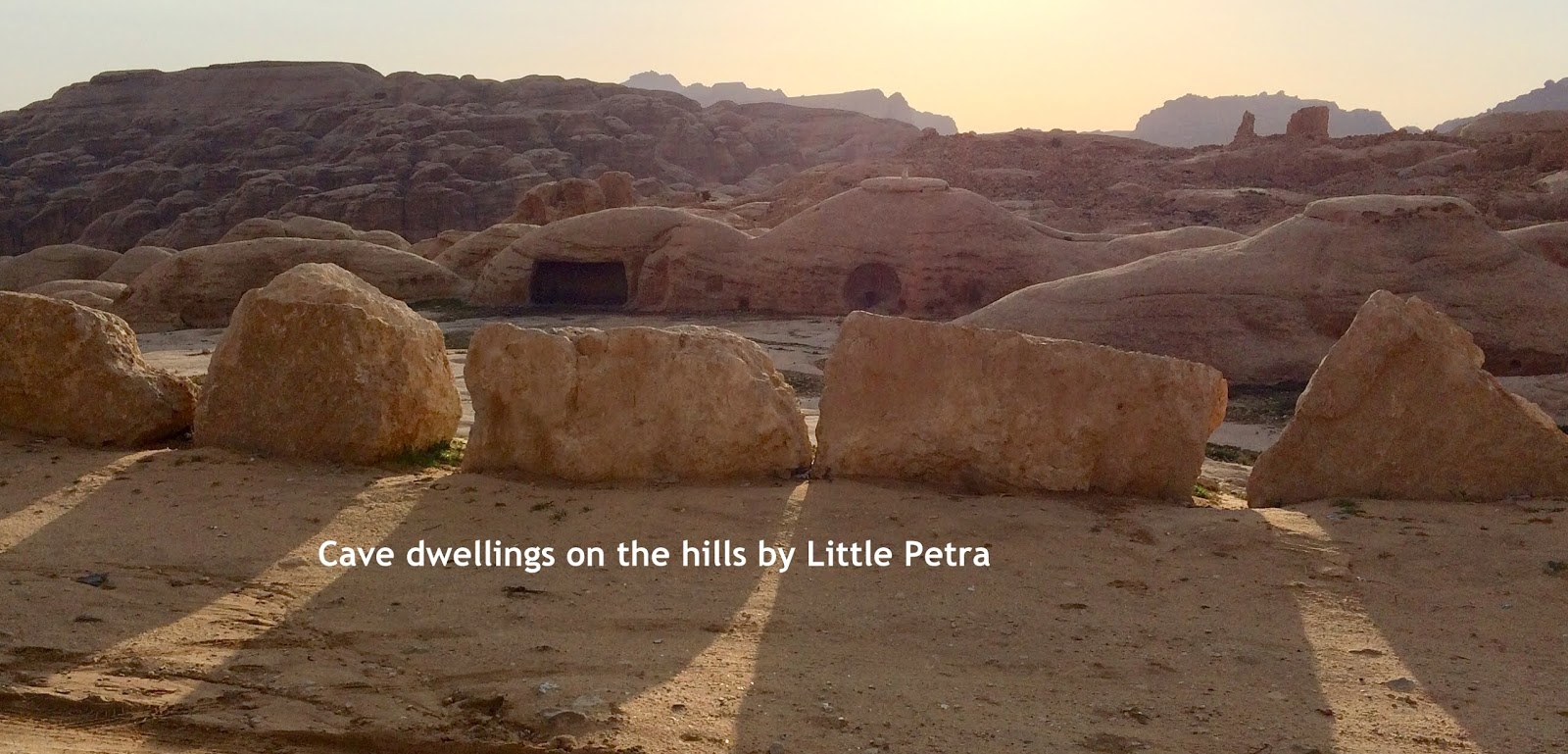
The road out was interesting as we passed many cave dwellings now unoccupied 
The last two photographs show Petra town from the heights above. One can see the whole main site as well as other parts. Read the captions carefully.  

A huge stone on the way back. Was it called The Elephant's Trunk? 


Any text in quote marks is from Wikipedia as the author felt the facts are well represented directly. Thank you Wikipedia. 
Text and photographs copyright of the author. No part of this article or photographs maybe transmitted or reproduced by any means, electronic, mechanical, photocopying or otherwise, without written permission. Do contact the author on email -- helpthesun@gmail.com