Thursday, 12 January 2017

Lord Buddha's statue - one of the largest in the world in Bhutan


The statue of Lord Buddha is still being completed - the whole area is still under development and finishing for the last few years. The Buddha is massively large. They say that the surrounds will be complete only in

Built with international aid from Thailand and other well meaning countries and individuals, the statue itself is complete. It is visible from miles away.

 My first sight of it was when we went to visit the dzong in Thimpu. Exiting the steps, from atop, I turned right and suddenly right there, the Buddha was facing us. It’s unbelievably large.

It is at Sangayang Thimpu. It stands 71 metres tall – over 210 feet. Including the 20 metre dome or the Lotus throne.


I saw the statue from the outside only as I was not keen on any more climbing. ...there are many steps to climb if you wish to reach inside. 


I am told inside there are 125,000 smaller Buddhas besides numerous relics, mantras, precious substances, 34 major Mandalas, 33 minor Mandalas, and 72 Golden dragon pillars.


It reminded me of my visit to Lantau Island of Hong Kong (see blog on this site) as well as the sleeping Buddha in Bangkok.


It’s a great feeling to see The Buddha keeping an eye on the well being of Thimpu and its residents. It’s all powerful, all seeing, in its vastness and distance. 


Text and photographs copyright of the author. No part of this article or photographs maybe transmitted or reproduced by any means, electronic, mechanical, photocopying or otherwise, without written permission. Do contact the author on email -- helpthesun@gmail.com

Chele La Pass - on Bhutan's highest motorable road - 4,000 m


Paro airfield
A lot of tourists go to Haa Valley – it’s actively promoted by the Govt as there are a few villages there which are economically backward and tourists can see the semi primitive lifestyle. 

We had originally considered it but then decided that it was far too long a distance to travel – up and down mountain passes – having already been on enough mountain passes and curling S roads on this short trip- so we gave it a miss. I would rather spend two days in Paro than driving up and down mountains just to see a valley without much to do. However as we were in Paro on the last day, the guide felt we should see Chele La Pass – the highest motorable road in Bhutan at 3,999 metres. 

As usual Sonam did not say much other than to express that the drive was beautiful and not to be missed. The road begins six kms from Paro. And is 38 kms up. So it’s a total of 44 kms from Paro. Haa Valley is 68 kms away. Sounds so close but getting there takes time. To drive that distance to the Pass, at reasonable speed takes around 90 minutes enjoying the scenery. The roads are not dual carriageways – they are a mix of dirt track being repaired and tarred road. All 2 lane. 
We go past the Paro airfield, a refreshing change in its openness and greenery as compared to other world airports which are covered by concrete barriers and vast buildings. Here security is tight but discrete; buildings are pretty and blend into the landscape. There is a distinct feeling that these structures must not stand out but go with the flow of the country’s heritage. 
Just past the signpost 
 We started climbing and went through the dark forest. The sun was visible on and off and in the shade it was cool.

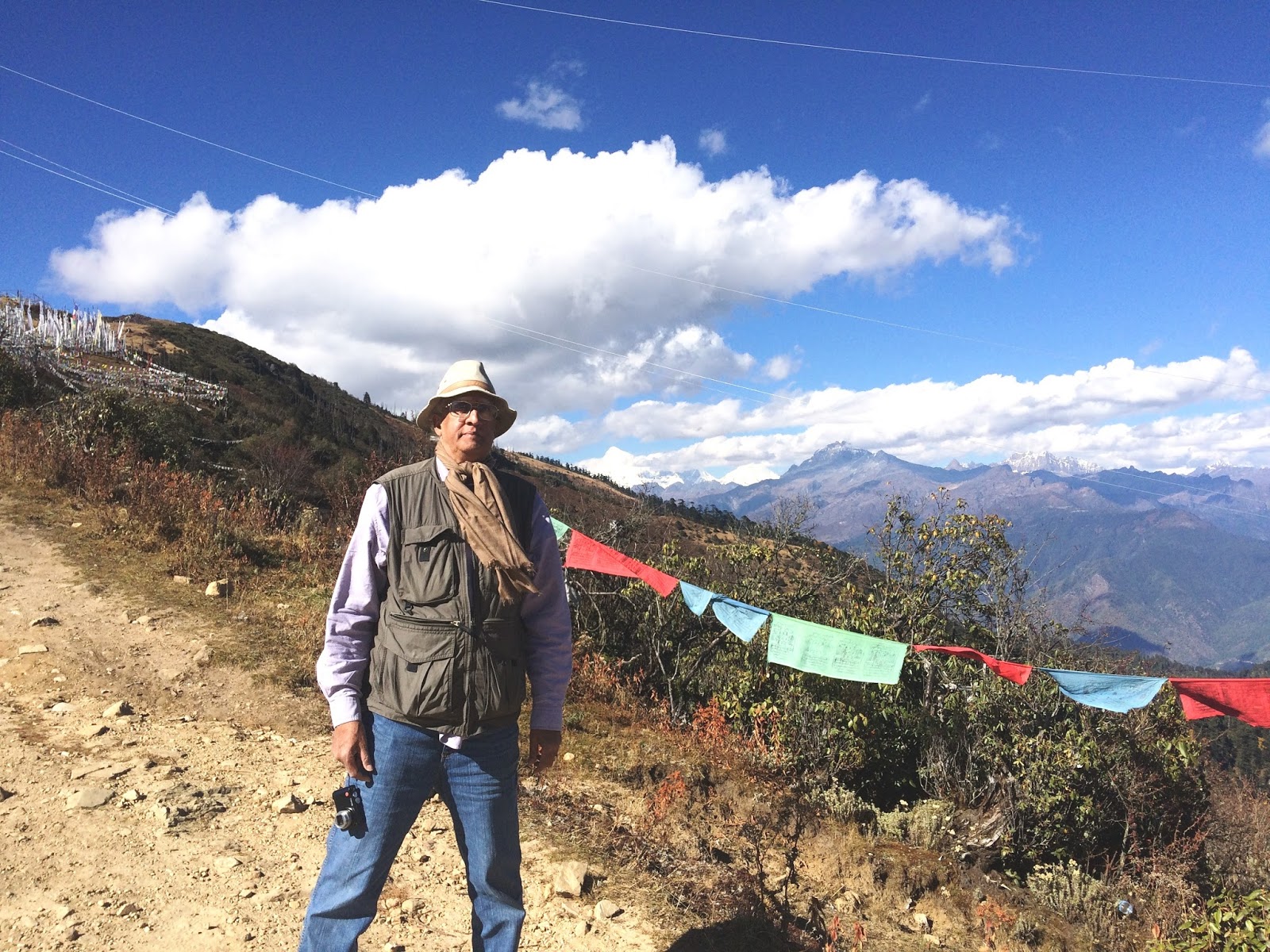
After a series of sinuous S bends and turns, we seemed to arrive at the top. There were two cars there and the one thing which strikes the visitors eyes are the numerous prayer flags all around in grouped sets. I did not count each set but had been told that these are put up in a certain number as dictated by Buddhism. It was windy so the flags were fluttering full steam. There was a group of three young people who were installing yet another set of prayer flags on the hillside. 
There is a signpost stating that this is the highest motorable road in the country. A typical good photo op.                                                                                
Bracing myself against the wind !

its a place of breath taking beauty and apparently a botanist's paradise. the views are spectacular - Mt Jumolhari, Mt Jichu Drake and the adjoining peaks to the north west. There is a lot of spirituality around. 

Then, as my family were staying near the car, Sonam took me further up – actually we were looking for a quiet secluded place to relieve ourselves!! We walked up and up and off the road. 


Suddenly, we saw a small hut nearby and facing it a valley. Deep down below, miles away, was the Haa valley.


From where we stood, the place looked miniscule. With my camera, I took a few close up shots without worrying on what was on the lens, as the wind was of concern: it was really hard to stand there. 


The photos reveal what the naked eye could not see!! 


We stayed there for another ten minutes or so, having a good look at the valley and the mountain peaks knowing well that we would not be coming here again; so absorb it in the mind’s eye. 


Text and photographs copyright of the author. No part of this article or photographs maybe transmitted or reproduced by any means, electronic, mechanical, photocopying or otherwise, without written permission. Do contact the author on email -- helpthesun@gmail.com

Wednesday, 7 December 2016

Bhutan's national animal - I've never seen one before - its so unique

The TAKIN is Bhutan's national animal. Declared by the Govt in November 1985. 
The Thimpu zoo is outside the town. You don't realise it but it is actually part of a natural forest type area. The entry is on the road side and only after you have crossed a few metres that you realise the zoo has a path which goes up and down the hilly area.  In Bhutan, most things are up and down!! Its a mountainous country. 


The Takin is a part of the goat antelope family. Its larger and stockier. Its plump and bovine body is covered with dense long yellow to brownish hair. It has short stocky legs with large two toe hooves with strong dew claws which helps it in this environment. 


They are generally found in the 1,000 to 4,000 ft altitude. 

It has a large head and a large Romanesque nose. Male and female of the species have large horns which are about a foot long, curving backwards and upwards. 


 The Takin is found in the Himalayan and western China region.  Its a protected species. Data shows that its main predators are bears, snow leopards and wolves.

The Takin eats in the early morning or late afternoon - the leaves from the deciduous trees as well as bamboo, shrubs and herbs.   


Text and photographs copyright of the author. No part of this article or photographs maybe transmitted or reproduced by any means, electronic, mechanical, photocopying or otherwise, without written permission. Do contact the author on email -- helpthesun@gmail.com

Bhutan's technical education schooling system


 Bhutan's Government has an excellent education system aimed especially at children who are disadvantaged and who have no future unless they are given some form of training. 

They are taught painting, carpentry, metalwork, sculpture, embroidery and tailoring, traditional shoe making  etc. 

Duration of courses vary but minium is for four years.  The first two years are elementary and in the third year of the course it becomes more serious. 

Here we have boys learning how to use carpentry tools by carving into wooden panels various local designs.   

Below is a Carpentry classroom 
This is the classroom where boys and girls learn stitching and tailoring as well as embroidery. Tailoring is a year's course after the basics are learnt. 

This is the traditional Bhutanese shoe. The design has a meaning. Look carefully. 

The boot has a long vertical strip which represents a snake. 
The tip of the boot has a nose and resembles the pig's.
The eyes painted on are those of a bird representing desire. 

In life there are three poisons - anger, hatred, desire.

By having these on the boot, you are stamping these out underfoot !!

Wonderful imagery , beautiful shoes and realistic logic.  


A young girl patiently learns embroidery. They are very proficient by the time they leave school. A sample of their work can be seen on the banner as well as below.  


Here the young man is doing metal work. 


The drawing and painting course is a six year program. The students appear to do repetitive drawing in the initial years, then progress to sketches and finally make grids to undertake larger drawings. They use acrylic paints. From what little I saw in our hour long stay in the school, the facilities and tools could definitely be improved.  The material used are not that good, they dont have easels and I believe that the basics are not really taught as they should be - teachers come and sit doing their own work and supervising. Maybe its different. I hope so.  
This is the tailoring classroom with dummies etc for fittings. 


Hordes of tourists come to see the school and students so I dont know how they can concentrate when we are all walking around them, taking photos and disturbing their studies. Its a wonderful idea to teach these subjects to the deprived youngsters but they need motivation too. One hopes that the Governing Body will create better avenues for the kids. 


Text and photographs copyright of the author. No part of this article or photographs maybe transmitted or reproduced by any means, electronic, mechanical, photocopying or otherwise, without written permission. Do contact the author on email -- helpthesun@gmail.com