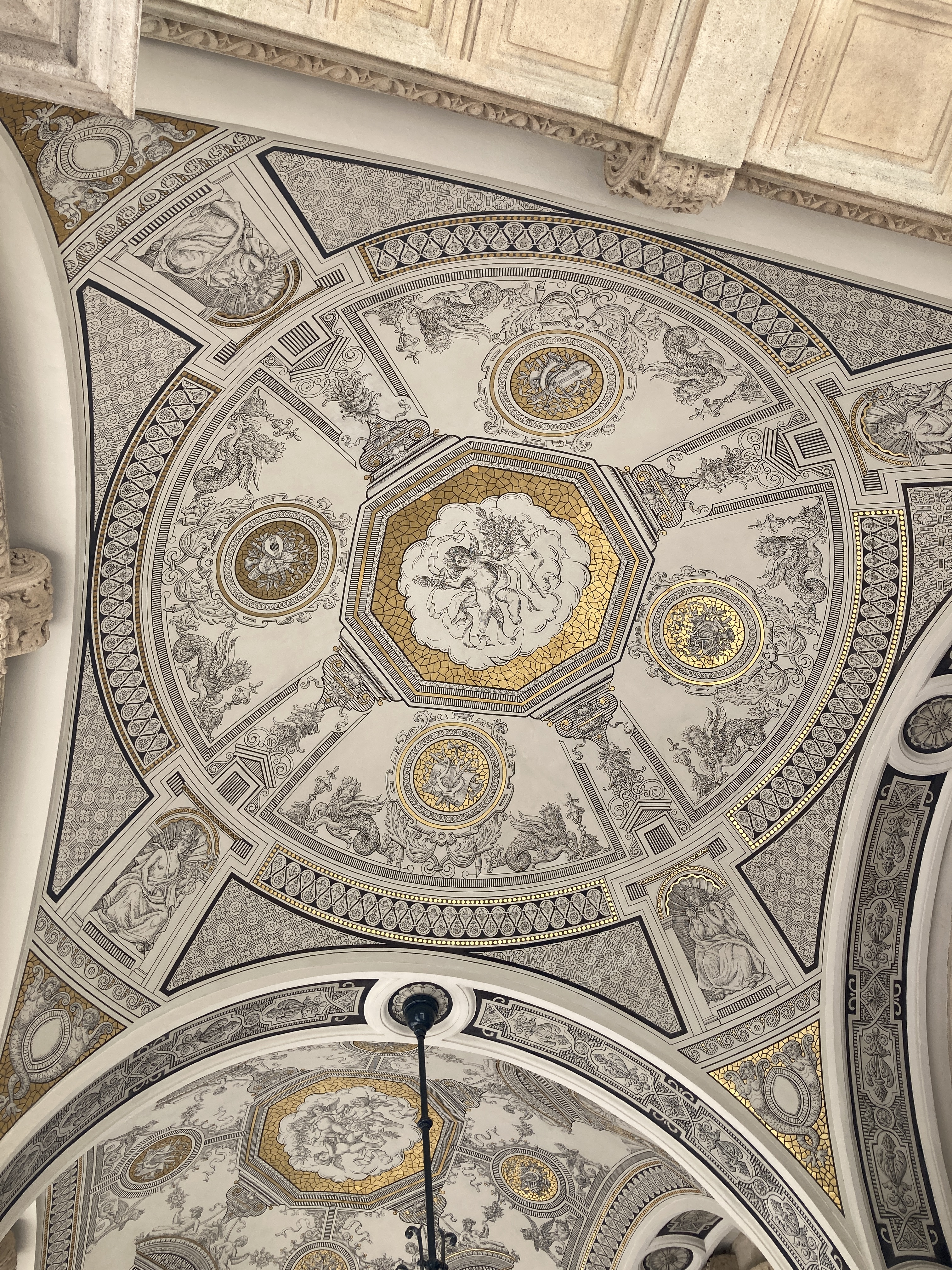
A highlight of Budapest
is to visit the Opera House – in the daytime, but if possible to attend a
performance. Our excellent guide, during the morning walk of the city, had the Opera
House as the first stop. In the relatively dim interior, as none of the main
lights were on, one discerned the grandeur of the place. We were only allowed to
see the entrance foyer as we were not part of the formal guided tour.
We were keen to see
a performance here – I was certain the main hall would be really worth seeing. That
evening was Ariadne in Naxos and next evening was a Ballet performance. The
latter was preferred but we were on a full day tour of Danube Bend and
returning late; so we settled for Ariadne with some concerns as Greek mythology
was involved.
We arrived early as
I wanted to see the whole inside of the building. There were four floors… on
inquiry, I found a lift (elevator) hidden away by the side and unless you
asked, you would never have seen it !
Straight up to the
top – there is a large bar cum catering area. Superb paintings on the ceiling
and gold work through out. What an atmosphere ! I went out to the balcony and saw the whole
avenue across.
Walking down the
majestic staircase, with the huge chandeliers casting a warm yellow glow all
over, seeing the crowd entering below was interesting. Everyone was well
dressed.
I had selected our
seats carefully - by the entry point aisle and at the rear so
that we had a clear view and quick exit if required. The empty Royal Box was behind us to our
right. The Opera House had the Orchestra in the pit by the stage. Unfortunately
the Conductor’s podium light faced at an angle directly hitting my eye so I had
to use the person in front of me as a shade !!
Our
experience at the Opera was most unusual.
Here were two
relatively well educated Indians, familiar with the English language who went
to see an opera in Budapest, Hungary. The story was of Ariadne in Naxos, an ancient
Greek mythological tale spoken by the actors in German because the opera was written
by Richard Strauss. However, for the local audience we had Magyar script projected
on a screen just above the theatre’s curtain.
The opera was far
too modern and totally incomprehensible – I am sure to the sophisticated local
audience too, unless one had read the whole long synopsis in the programme. However,
surprise surprise, to add to your woes,
there was no physical programme
– you had to scan a QR Code which was displayed by the entry door and download
the whole programme of some 10 pages of information on the Opera’s mythological
history, the author’s raison d’etre for writing it, the details of the cast,
comments of various writers on the opera etc. Totally impossible to appreciate
all this on a 4 or 5” cell phone screen. This is really taking modern technology
to unrequired heights and at its worst.
We left after the
first act. Our visit was not wasted as we did enjoy the glory of the whole building which was our intention. 
The view from the balcony at the very top The ceiling of the Bar cum Catering area.
To better
appreciate the visuals of my blog, I felt that you could refer to basic
information on the building – what better than straight from Wikipedia.
“Originally known as
the Hungarian Royal Opera House, it was designed by Miklós Ybl, a
major figure of 19th-century Hungarian architecture. Construction began in
1875, funded by the city of Budapest and by Emperor Franz Joseph I of Austria-Hungary, and the new
house opened to the public on the 27 September 1884. Before the closure of the
"Népszínház" in Budapest, it was the third largest opera building in
the city; today it is the second largest opera house in Budapest and in
Hungary.
Touring groups had performed operas in the city from the early 19th
century, but as Legány notes, "a new epoch began after 1835 when part of
the Kasa National Opera and Theatrical Troupe arrived in Buda". They
took over the Castle Theatre and in 1835, were joined by another part of the
troupe, after which performances of operas were given under conductor Ferenc Erkel.
By 1837 they had established themselves at the Magyar Színház (Hungarian
Theatre) and by 1840, it had become the "Nemzeti Színház" (National
Theatre). Upon its completion, the opera section moved into the Hungarian
Royal Opera House, with performances quickly gaining a reputation for
excellence in a repertory of about 45 to 50 operas and about 130 annual
performances.
Today, the opera house is home to the Budapest Opera Ball, a society event dating
back to 1886.
Many important artists were guests here including the composer Gustav Mahler,
who was director in Budapest from 1888 to 1891 and Otto Klemperer,
who was music director for three years from 1947 to 1950.
In the 1970s the state of the building prompted the Hungarian State
to order a major renovation which eventually began in 1980 and lasted till
1984. The reopening was held exactly 100 years after the original opening, on
the 27 September 1984.
It
is a richly decorated building and is considered one of the architect's
masterpieces. It was built in neo-Renaissance style, with elements of
Baroque. Ornamentation includes paintings and sculptures by leading figures of
Hungarian art including Bertalan Székely, Mór Than and Károly Lotz. Although in size and capacity it
is not among the greatest, in beauty and the quality of acoustics the Budapest
Opera House is considered to be amongst the finest opera houses in the world.
The
auditorium holds 1,261 people. It is horseshoe-shaped and – according to
measurements done in the 1970s by a group of international engineers – has the
third best acoustics in Europe after La Scala in Milan and the Palais Garnier in Paris. Although
many opera houses have been built since, the Budapest Opera House is still among
the best in terms of the acoustics.
The
decoration of the symmetrical façade follows a musical theme. In niches on
either side of the main entrance there are figures of two of Hungary's most
prominent composers, Ferenc Erkel and Franz Liszt. Both were sculpted by Alajos Stróbl. Liszt is the best known
Hungarian composer. Erkel composed the Hungarian national anthem, and was the first
music director of the Opera House; he was also founder of the Budapest
Philharmonic Orchestra.
Each
year, the season lasts from September to the end of June and, in addition to
opera performances, the House is home to the Hungarian National Ballet.
There
are guided tours of the building in six languages (English, German,
Spanish, French, Italian and Hungarian) almost every day.
The
foyer has marble columns. The vaulted ceiling is covered in murals by Bertalan Székely and Mór Than. They depict the nine Muses.
Wrought-iron
lamps illuminate the wide stone staircase and the main entrance. Going to the
opera was a great social occasion in the 19th century. A vast, sweeping
staircase was an important element of the opera house as it allowed ladies to
show off their new gowns.
The
main hall is decorated with a bronze chandelier weighing 3050 kg. It
illuminates a fresco by Károly Lotz, depicting the Greek gods on
Olympus. The central stage proscenium arch employed the most modern technology
of the time. It featured a revolving stage and metal hydraulic machinery.
The
royal box is located centrally in the three-storey circle. It is decorated with
sculptures symbolizing the four operatic voices - soprano, alto, tenor and bass”.
Text and photographs copyright of the author. An excerpt of the article from Wikipedia has been gratefully acknowledged by the author. No part of this article or photographs maybe transmitted or reproduced by any means, electronic, mechanical, photocopying or otherwise, without written permission. Do contact the author on email -- helpthesun@gmail.com

 You need to buy a ticket in advance. To get
to the entry point entails walking the whole bridge and then doing a U-turn, if
you come down the wrong side ! You have the option of climbing up to the top or
taking the lift (elevator). That was my preferred option. There is a stiff
security check so less you carry the better. Go on a weekday and as early as
possible to beat the crowds.
You need to buy a ticket in advance. To get
to the entry point entails walking the whole bridge and then doing a U-turn, if
you come down the wrong side ! You have the option of climbing up to the top or
taking the lift (elevator). That was my preferred option. There is a stiff
security check so less you carry the better. Go on a weekday and as early as
possible to beat the crowds.

 The construction of the first Medieval London
Bridge was started in 1176 and continued for 33 years, under Peter de
Colechurch’s instructions. The new stone bridge, completed in 1209, was
designed with 19 arches and a gatehouse accessed by a drawbridge. It was
populated with around 200 shops and businesses, so crossing the river became really
hard. The bridge’s endurance was also put in danger by carrying such a heavy
charge on it. The shops above it, among others, affected London Bridge’s
strength. Although the bridge was not destroyed in the 1666 fire, its stability
was seriously deteriorated.
The construction of the first Medieval London
Bridge was started in 1176 and continued for 33 years, under Peter de
Colechurch’s instructions. The new stone bridge, completed in 1209, was
designed with 19 arches and a gatehouse accessed by a drawbridge. It was
populated with around 200 shops and businesses, so crossing the river became really
hard. The bridge’s endurance was also put in danger by carrying such a heavy
charge on it. The shops above it, among others, affected London Bridge’s
strength. Although the bridge was not destroyed in the 1666 fire, its stability
was seriously deteriorated.