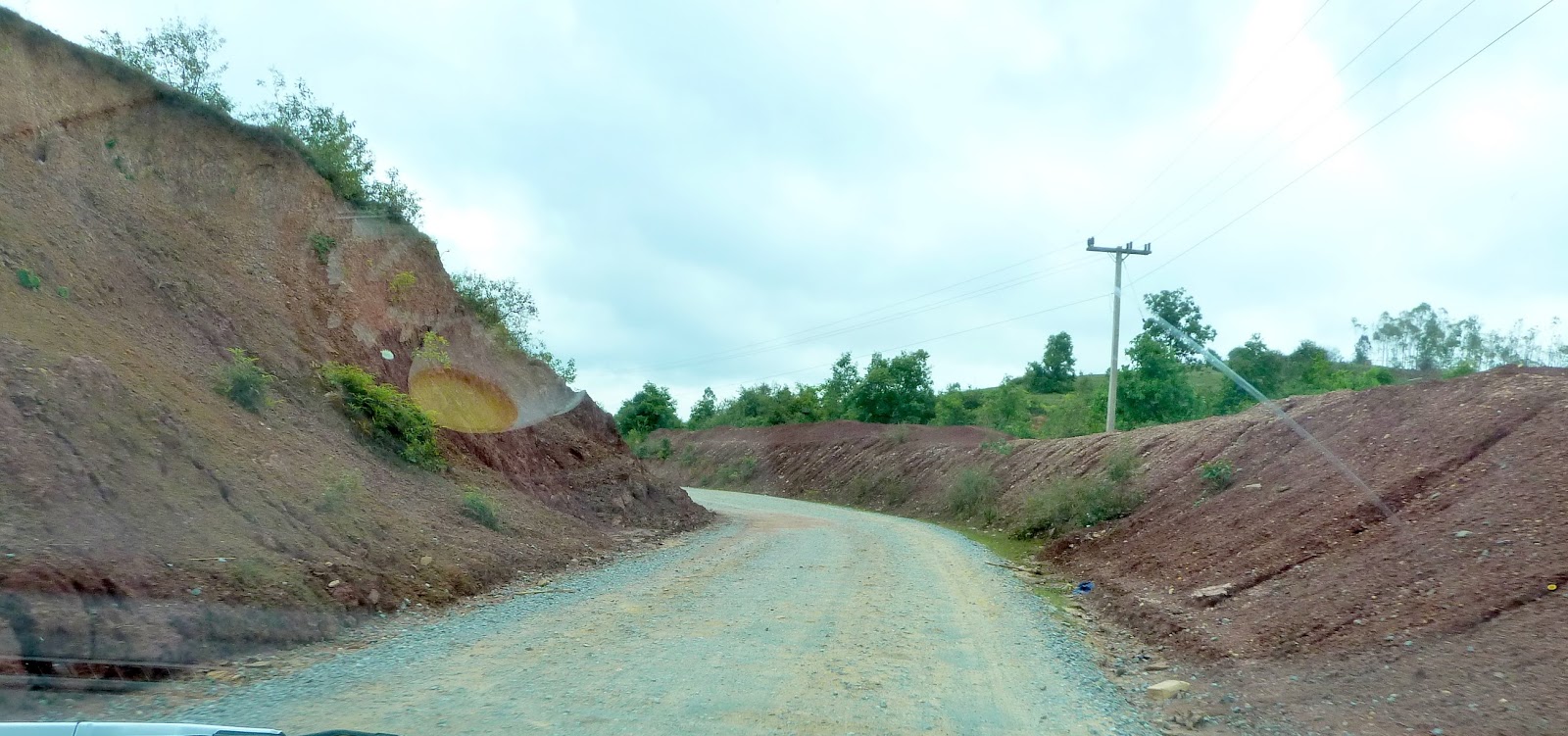
Arrive into Luang Prabang and you realise that a
trip on the River Mekong is a must. Well, you can do either a sunset cruise or
a trip to the Pak Ou caves. Or both if you have time on your hands. The Pak Ou
caves are part of any tourist’s itinerary. Pak Ou means Mouth
of the River. People have lived in these caves since the 14th
C. So well packaged is the concept of
the tour that you feel that one must not miss it. In fact, what is really more
enjoyable and interesting is the river trip rather than the cave, especially if
you have seen Buddha statues elsewhere which are far superior in number and
quality – i had seen Pindaya caves in Myanmar a few years ago and it’s embedded
in my memory.
Arrive into Luang Prabang and you realise that a
trip on the River Mekong is a must. Well, you can do either a sunset cruise or
a trip to the Pak Ou caves. Or both if you have time on your hands. The Pak Ou
caves are part of any tourist’s itinerary. Pak Ou means Mouth
of the River. People have lived in these caves since the 14th
C. So well packaged is the concept of
the tour that you feel that one must not miss it. In fact, what is really more
enjoyable and interesting is the river trip rather than the cave, especially if
you have seen Buddha statues elsewhere which are far superior in number and
quality – i had seen Pindaya caves in Myanmar a few years ago and it’s embedded
in my memory. 
“The southernmost Pindaya cave extends for about 490 feet. It is known for its interior which contains over 8,000 images of Buddha. Some of the older statues and images in the cave have inscriptions dating to the late 18th century and the earliest one dates from 1773. The collection as a whole forms an impressive display of Buddhist iconography and art from early Konbaung era to the modern period. No other place in Burma displays such a range of style, not only in the images, but also in the ornamental thrones and reredos which surround the images.” I quote Wikipedia as it a statement expressing factually and beautifully what is at Pindaya – it is just mind blowing!

Anyway, back to Pak Ou. The caves are NNE of Luang Prabang -
30 kms and 53 minutes away on Route 13. The actual boat trip is 40 kms but going
out takes two hours because we stop at Ban Sang Hai, euphemously called Whisky
Village, and then move to the cave.

They gave my nephew a wonderful
vegetarian meal as we had requested it before we began the trip. The our costs
US$ 25 per pax including the lunch and guide who comes along with you for the
whole tour.
 |
| a panoramic view of the river trip |


 |
| climbing to the whisky Village |
The village is a total rip off – we stopped for 45 minutes on a hot afternoon. First like any river cruise, you have to climb rickety steps to land.
There, as you see from the photos, we saw one small shop selling bottles of spirit
made from either white rice or red rice. Yeast is added and the fermentation
process takes two weeks. Then the liquid is boiled for two hours, cooled and
filtered. For touristic value, rather than for local consumption I believe, they
add scorpions, snake and other venomous creatures.
I remember that I had crossed from Chiang Mai across to the point where Myanmar, Laos and Thailand meet at one particular point - many years ago in a fast longboat where they showed us many such shops.


Our time was up at the caves and we had to return back to the boat. Climbing up, we came across a large party of Argentinians, Spaniards and Paraguayans!! So far from their continent.
But that’s the beauty of Laos – small, beautiful, laid back and welcoming to all foreigners. One would never know that it is still a true communist regime as politics is never discussed by a single local. You don’t know that there is 11 pm curfew for all and that restaurants close by 10.30 pm until you find yourself without food at that hour – as we did on our first night. But even then, we loved Luang Prabang with its wonderful ambience and architecture. A true World Heritage City.
Text and photographs copyright of the author. No part of this article or photographs maybe transmitted or reproduced by any means, electronic, mechanical, photocopying or otherwise, without written permission. Do contact the author on email -- helpthesun@gmail.com
 |
| The red or white rice along with clear or coloured whisky - no extras! |
 |
| An extra element ! |
 |
| This is the still in which they make the illicit stuff along with the cooling vats. |
I remember that I had crossed from Chiang Mai across to the point where Myanmar, Laos and Thailand meet at one particular point - many years ago in a fast longboat where they showed us many such shops.
A Dutch
couple and I had challenged each other to try the snake whisky. Eventually we
both did – it was refined rotgut – harsh and fiery. I had even brought back
some bottles with the cobra in them and gifted to colleagues.
So, this time, it
was just a look session and no trying, though we did try the plain white
whisky. Pleasant, tasteless; but at my age, I think I prefer my malts instead!!

 |
| Cobra or scorpion or both? Your choice. |
 |
| Weaving local textiles |


 |
| if you are familiar with Indian deities, this is a perfect example |
There are a few textile stalls right by the whisky shop and
then as you walk further in, you come across a Wat.
On entering, you see that
from each of the four exits of the wat, they lead to lanes having shops where
textiles are woven right in front of you.
This large handloom industry produces
shawls, drapes, cushion material etc. Obviously being handloom, the fabric
width is not more than three feet or so.
We went to the wat which has ornate carving, gold paint everywhere and a couple of typical Indian deities including the monkey god!! Strange to find it here in the midst of nowhere!! It was far too hot so within 15 minutes we were back in the coolness of the boat.

We then proceeded to the caves. Very pretty scenic route – this was more
enjoyable than the caves themselves!
The
first recorded use of the Pak Ou caves for religious purposes was when the
local populace worshipped Phi or the Spirit of Nature. Local belief has that
the cave is associated with a River Spirit – understandable as it sits atop the
River Mekong.
 |
| The Lower Caves visible from the river. See the Buddha statue inside?? |
Traditional history has the belief that the Lao
first entered the valley in the mid 8th C; after moving southwards
from south China. It was not until considerably later that Buddhism spread into
this area from India. It is established fact that the Lao Royal Family had
adopted Buddhism by the 16th C.
The caves received royal patronage
until 1975. Every year, the king and the people of Luang Prabang made a
pilgrimage during New Year celebrations. They commissioned artisans to make
beautiful sculptures. Hence many of the carvings date from between the 18th
to 20th C.

The more than 4,000 Buddha sculptures found in the
Tam Ting caves are actually placed there by worshippers over time. They are
mostly carved of wood or moulded from a tree resin coated with red or black lacquer
and sometimes with gold leaf on top of the lacquer. Very few are made from
animal horn, ceramic or bronze.
 |
| a beautifully made walkway of bamboo woven together |
There are three common poses depicting important
stages in Buddha’s life:
-
Calling for Rain – standing pose with
arms pointing downwards
-
Calling the Earth to Witness – a
seated figure and one hand extended downwards
-
Meditation – a figure seated with
crossed hands
There are two other figures:
-
Stop Arguing – a standing figure and
palms extended outwards
-
Reclining – where the Buddha is reclining.
But these are not common.

The Lower Cave which visitors arrive at first is a
prominent landmark visible from far in the Mekong River. Paved pathways lead up
to this cave as well as the upper cave some 60 metres above the river.


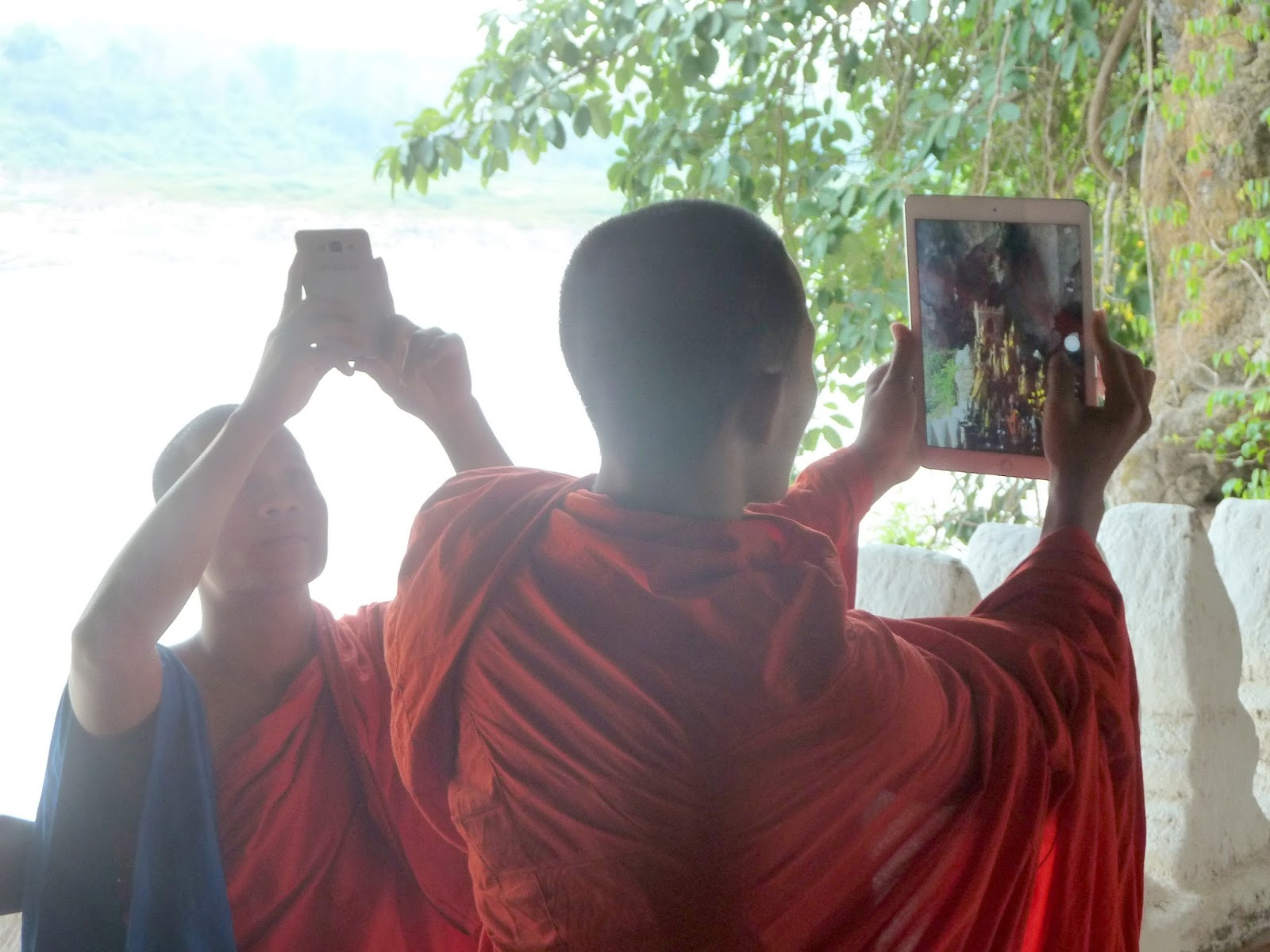 |
| my favourite photo - an ancient religion, student monks and modern technology |
In the lower cave, they claim that 2,500
sculptures are located. A central point for tourists and believers is the alter
closest to the entry where flowers, incense and candles are offered. Lion statues
guard the entry whilst a Ramayana sculpture of a hermit linked to local forest medicines
sits immediately above the lower entry platform. A large stupa like structure
surmounts the highest platform. A smaller stupa structure is on the cliff face
to the south.
 |
| en route to Upper Cave |
There is a small spring which supplies holy water
used during the annual New Year ceremonies.
The Upper Cave - You climb and climb these
horrendously huge wide steps. I hate climbing steps. I can walk for miles on
flat land but climbing is anathema. Luckily I had a gecko keeping me company, step
for step, for many steps and that lightened my stress. There are 215 steps
to the top from the Lower Cave. Yes, I counted them!
 |
| my companion for many a high rising step |
The entrance to the Upper Cave has a lady selling exquisitely
designed floral prayer offerings.
The entrance is enclosed by a carved wooden frieze
which at one time supported massive wooden doors, at present, so far as I could
see, there was a metal gate which one passed through and which was locked
presumably at night. There is a sculpture of Buddha’s disciple sitting by the
gate on a pedestal.
 |
| prayer floral offerings |
Inside, the cave becomes darker as you progress
inwards. It extends some 55 metres – in fact by the time I had walked some 50
feet I was in total darkness and luckily I carry a torch always so I could
flash it on the walls.
Even then, the darkness was so powerful that the light
just did not function clearly. I stayed where I was and just aimed my camera
and took the photos in various exposures so I eventually got what I needed.
 |
| the Upper Cave - taken with great difficulty due to total darkness |
 |
| stairway to heaven |
According to my friends, to the left of the entry
is a carved wooden water channel and miniature house for ceremonially washing
the images of Buddha.
Sunflowers and Lao art motifs decorate the trough.
Further into the cave are groups of sculptures. – Some
of them more than 1½ metres in height. Some are really small. Rumour has that there
was at one time a large seated Buddha here but frankly, nobody knows.
Our time was up at the caves and we had to return back to the boat. Climbing up, we came across a large party of Argentinians, Spaniards and Paraguayans!! So far from their continent.
But that’s the beauty of Laos – small, beautiful, laid back and welcoming to all foreigners. One would never know that it is still a true communist regime as politics is never discussed by a single local. You don’t know that there is 11 pm curfew for all and that restaurants close by 10.30 pm until you find yourself without food at that hour – as we did on our first night. But even then, we loved Luang Prabang with its wonderful ambience and architecture. A true World Heritage City.
Text and photographs copyright of the author. No part of this article or photographs maybe transmitted or reproduced by any means, electronic, mechanical, photocopying or otherwise, without written permission. Do contact the author on email -- helpthesun@gmail.com