Saturday, 20 January 2018

Dholavira, a Harappan city over 2,500 years old, reveals its secrets

We had planned to visit this Harappa site for the last five years and eventually managed it in December 2017. 

From Ahmedabad to Dholavira it’s a very long drive so we halted at Wankaner which was a big mistake. Our hotel Royal Oasis was  terrible and we left early next day for Dholavira. 

Reaching there just around 1.30 pm, nearly five hours on the road in the wintry hot sun. 


You hit the White Rann about 15 kms from Dholavira – it’s an awesome stretch of straight road built over what was water. As you drive on this long stretch, there is endless waste land – all white glittering in the heat.

It’s all salt. 


Stare at it and you will hurt your eyes. This is the best place to see the White Rann as it gets no whiter elsewhere.


We saw many tourists stopped by the wayside taking photographs as it’s a unique experience.

As you see the water colour, you realise the different chemicals and salts in its composition. 
The Dholavira Tourism Resort where we stayed gives the appearance of being run by the Gujerat Govt. It is in fact run by the local sarpanch who is an affable man. He offers a full board with guided tour to the Harappan site, Sunset Point evening drive, Fossil Park etc as part of the stay package. There is a reduced rate for single accommodation. HOWEVER, the main issues are the quality of accommodation – we were put up in the Kutch style old round buildings where the stench from the bathroom gutters was AWFUL. 


The rooms are basic, no furniture and bathrooms has tepid trickle of hot water. There is no room heater. There are a series of brand new AC tents which he has built but these were given to groups. The food is basic but plentiful. All vegetarian. Hygiene levels should not be looked at when staying here – the dining room has hay on the floor, less said about the kitchen the better. The staff however is warm hearted and helpful. There is a new resort which has come up before the BSF Camp so perhaps you should try that.

We were allotted a guide who was ignorant. We found that the sarpanch has stopped all accredited guides and brought in his own men!  Luckily we had been recommended Jaymal Makwana by a professional historian and heritage conservationist. We traced him on the site and spent nearly two hours with Jaymalbhai   learning all about Dholavira’s ancient past. So if you are there, do ask for him. He knew every angle having worked there from the very beginning under the guidance of the first archaeologist. 
I have published the actual sign boards from the site as this gives accurate data. 
There is a small museum with interesting information and surprisingly well written explanations in English and Gujerati. Good photographs. Decent lighting enabling you to read the captions!! 


The initial approach to the site appears difficult for senior citizens. The climb to the top means climbing over large stones of uneven surface and height. We found that there is a way around – go to the left side and take a curving sloping route up the site. You may miss a section of the site in the centre but you will see 90% of the site especially as the route down is the same slope avoiding high stepping stones. 

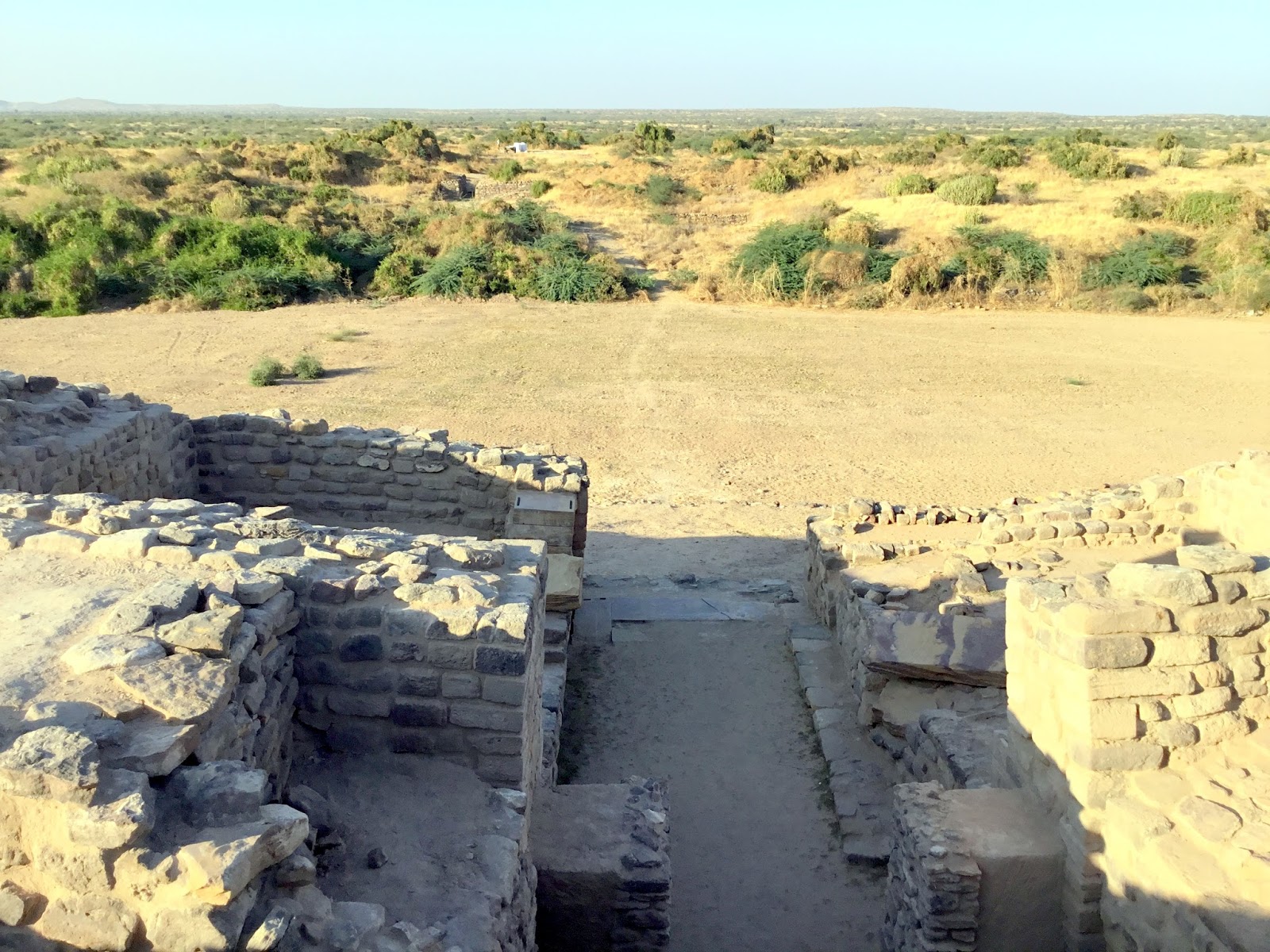
The site is amazing. It is incredible to think of what the culture achieved in those days – it’s a seven tier city in that there are seven distinct stages.  There is a detailed schematic of the city. Houses with various rooms, a bathroom which shows the water flow arrangement, the drainage system in place, the vast area where there was an amphitheatre.  We were told that the actual dig is a small fraction of what is really there underground. 


What was really fascinating was that the tourists come there from far parts of India. We were told that, apart from Gujerat tourists, they are generally from Bangalore, Chennai, Hyderabad, Kolkata and some from Mumbai. We met a group of youngsters who had driven down from Bangalore! I think that’s fantastic to see such a mixed group at such a far off place. Also important was that we saw no sight of any garbage – it was clean of any trash. Visitors did not shout into cell phones or call out to relations!! A remarkable sight in today’s constant Cellphone culture.  


Yes, the main negative was how the powers that be behave. See the photos of the District Magistrate’s car – do you see the number plate. Even that is acceptable. 


What was annoying was the blatant disregard of ASI Rules – the two cars were right up to the entrance area of the site which is not allowed to anybody. True representation of Indian political might!! 

We were just in time to catch the sunset at Sunset Point which is about 10 kms from the Harappan site. Awesome view especially with the island at one end and the sun at the other end of the camera frame. A fitting end to a great but tiring day. 


Text and photographs copyright of the author. No part of this article or photographs maybe transmitted or reproduced by any means, electronic, mechanical, photocopying or otherwise, without written permission. Do contact the author on email -- helpthesun@gmail.com

Thursday, 11 January 2018

The famous Wild Ass Sanctuary in the Little Rann of Kutch

We had wanted to visit this sanctuary since last 15 years but managed it only just now!! Its because its not really in Kutch - its off centre for a Kutch trip. So, on our Dholavira trip,  we returned via Sayla which is 90 minutes away from the sanctuary. 
the Forest Office for the tickets is in a bungalow off a lane in Bajana. The rates in Gujerati are pasted on the wall along with the guides list. its mandatory to have a guide as the average person will get lost in the vast expanse of the sanctuary.  Formalities are fast and as we had arrived mid morning rather than early morning, there was no queue and the guide was available. 


The guides must be of varying quality. our chap Mr Malek was dumb. The guides are given  a training of 10-15 days and then let loose with various bird and animal books for identification!! 

our guide's knowledge was BASIC. He did not speak unless asked and I had to tell him he was in the wrong profession if he could not tell us any details of the area or the species. 
He could tell the driver the route to take but he was totally vague on the bird species and on the various fauna and flora. 
So, if you take a guide, check him out first before going into the sanctuary.
We paid Rs 100 officially as the guide fee +a tip of Rs 100, so a total of Rs 200 for 2 hours work. Is this motivation enough for a guide? Its a thought to worry about. 

The first view in the sanctuary is of this vast expanse of parched dried land which has a whitish colour on it - this is the salt which comes up when the water has dried. After progressing a few kms, we came across this water body which had many birds on it. 
i have purposely attached parts of the Govt leaflet so that readers get an idea of the whole sanctuary and see whats available there. 


this is the sort of dried parched soil everywhere 


the first sight of the Wild Ass was this single magnificent specimen. He was alone. More horse than donkey. His brown coat had a beautiful soft colour to it. 
Surprisingly, we came across three groups of wild ass in pairs. 
The herd is highly disciplines and extremely alert. Whilst foraging, they keep an eye open for the unusual and promptly move off if they felt endangered. One herd went into a gallop as two cars were after them, we were lucky as they came close to us and we were sitting quietly in the car. 


This herd decided to go single file and then stopped watching us if we were going to cross their path. We just waited, so the leader eventually just turned around and went back. 
our final sight of the magnificent young birds as they cross to the water

Do go and visit this animal sanctuary as the Wild Ass and bird life are quite prolific. Its a great experience. 


Text and photographs copyright of the author. No part of this article or photographs maybe transmitted or reproduced by any means, electronic, mechanical, photocopying or otherwise, without written permission. Do contact the author on email -- helpthesun@gmail.com

Sunday, 3 December 2017

The world's second highest dam - Nurek


In Central Asian countries like Tajikistan and Uzbekistan, which have long been under Soviet rule or under Dictatorship and only now experiencing relative freedom, there are occasions when you ask a question and there is no answer to your query except for a shrug or a different answer.

Same applied to our trip to the Nurek Dam. We were a few days early before we joined our group across these two countries so as we had time to spare we took a trip to see Nurek Dam, on the River Vaksh in Tajikistan. It is the largest earth filled dam and the second tallest dam in the world. Begun in 1961, it was completed by 1980. 


The Nurek Dam was constructed by the Soviet Union and is uniquely constructed, with a central core of cement forming an impermeable barrier within a 300 m (980 ft)-high rock and earth fill construction. The volume of the mound is 54 million m³. The dam includes nine hydroelectric generating units, the first commissioned in 1972 and the last in 1979
The dam is located in a deep gorge along the Vaksh River in western Tajikistan, about 75 km (47 mi) east of the nation's capital of Dushanbe. There is a pleasant tree lined township near the dam, also called Nurek, houses engineers and other workers employed at the dam's power plant.

The reservoir created by the dam is the largest reservoir in the country. It is a popular weekend resort for the local population from around Dushanbe and this area. The water fuels the hydro electric plant and is used for irrigation of around 700 sq kms of farmland – transported 14 kms through the Dangara irrigation tunnel. 
It took 90 mins. for us to travel the 60 kms from Dushanbe to Nurek. We had an excellent guide with us who we pumped for information on the country. The drive there was very pleasant – we crossed many kms of vineyards and en route we saw many stalls selling different types of fruit. We bought some grapes from one of these stalls. -

On arrival, we could hear the roar of water before seeing it – it came from a rather large hole in the dam wall – suddenly it just came – a huge wall of water nonstop. It seemed they had opened some gates in the lake to let water go downhill. The water colour was an unbelievable blue. 
As courtesy required and as per law, we stopped to meet the local cop in charge of the security post. We found that the Army were not allowing any visitors as the Chinese and Tajik ministers were visiting (were they ministers ? – I doubt it as they came only in one car and no escorts) so we were told to go back. So, I decided to play upon his ego and started speaking to the Major using my guide as translator. We talked about him, his duties as a soldier, the duration of being a way from family, the toughness of such isolation etc. We shared nuts and grapes which we brought from the car. Eventually, he agreed that we could park the car a bit far from direct view and he would let us know as soon as the VIP’s went. Over an hour passed whilst we sat waiting. Well worth it.

We went through a security gate and climbed right up to the top, 300 metres up. There is an awesome view of the whole dam with the township below. There was just one family in a Mercedes car which showed that this person had some clout to belong up here at the top. The countryside is extremely hilly with grape vineyards everywhere.    We spent some time on the dam site as well as surrounds before returning back to Dushanbe. 


Text and photographs copyright of the author. No part of this article or photographs maybe transmitted or reproduced by any means, electronic, mechanical, photocopying or otherwise, without written permission. Do contact the author on email -- helpthesun@gmail.com