Tuesday, 28 November 2017

Tashkent's Museum of Applied Art - a unique private public gem


Address: 15, str. Rakatboshi, Yakkasaray district, Tashkent
Phone: (+998 71) 256-40-42, 256-39-43


Working hours: from 09:00 a.m. to 09:00 p.m. (w/o lunch, cash-desk closes at 05:00 p.m.)


Web site: www.artmuseum.uz
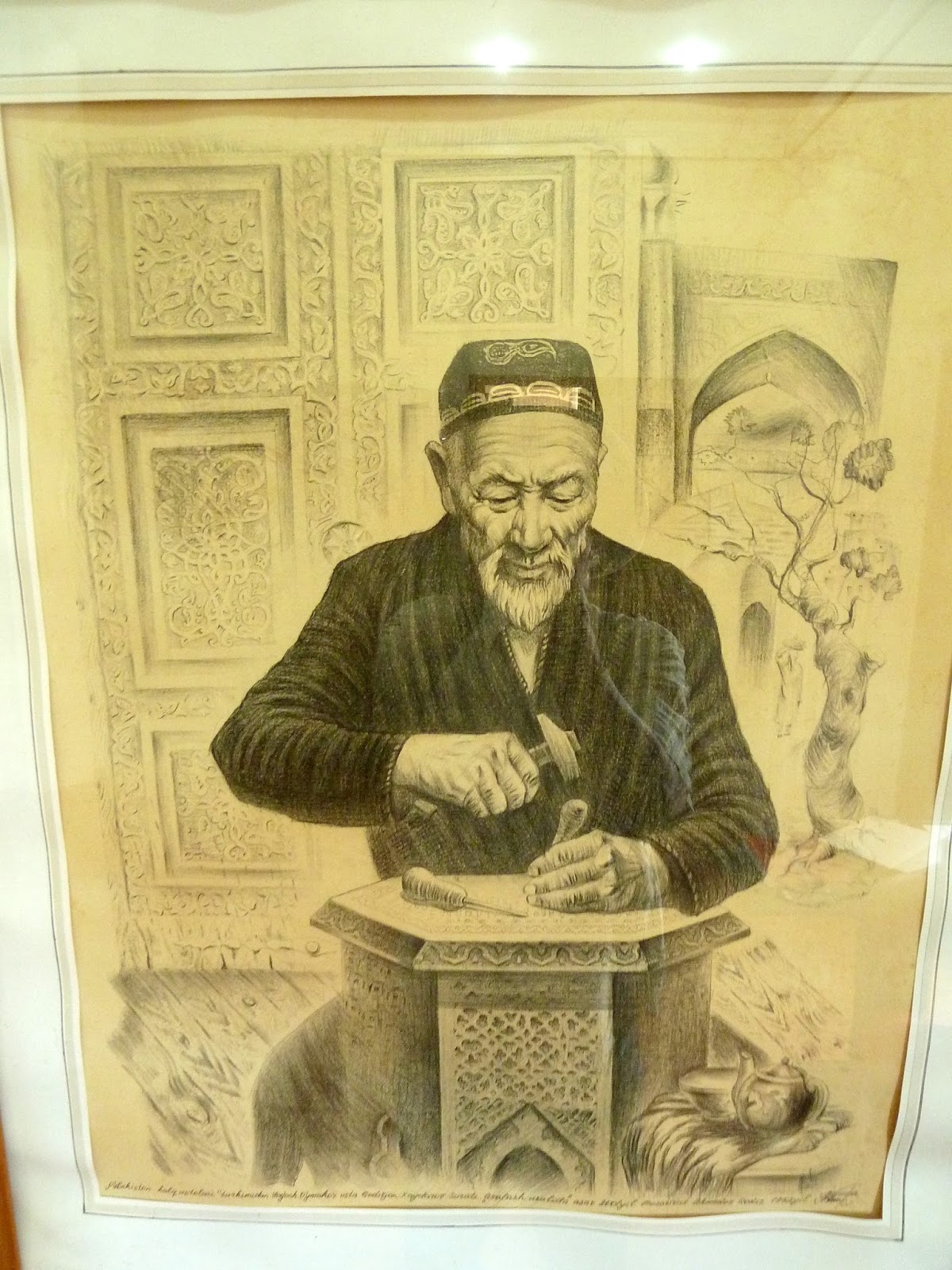


Sketches of various professions
adorn the first hall. Beautiful work.
Museum of Applied Arts is located in a house built by a Russian diplomat in the 19th cent. The building from the outside is unimposing. There is a large courtyard and after you pay the obligatory fees for the camera, and yourself, you start the tour from the far side – near a very finely carved door. Then you enter a unique kingdom and wonder how the owner must have felt when the Govt took over all his personal exhibits and made it their own, adding many more exhibits to the outstanding  collection.

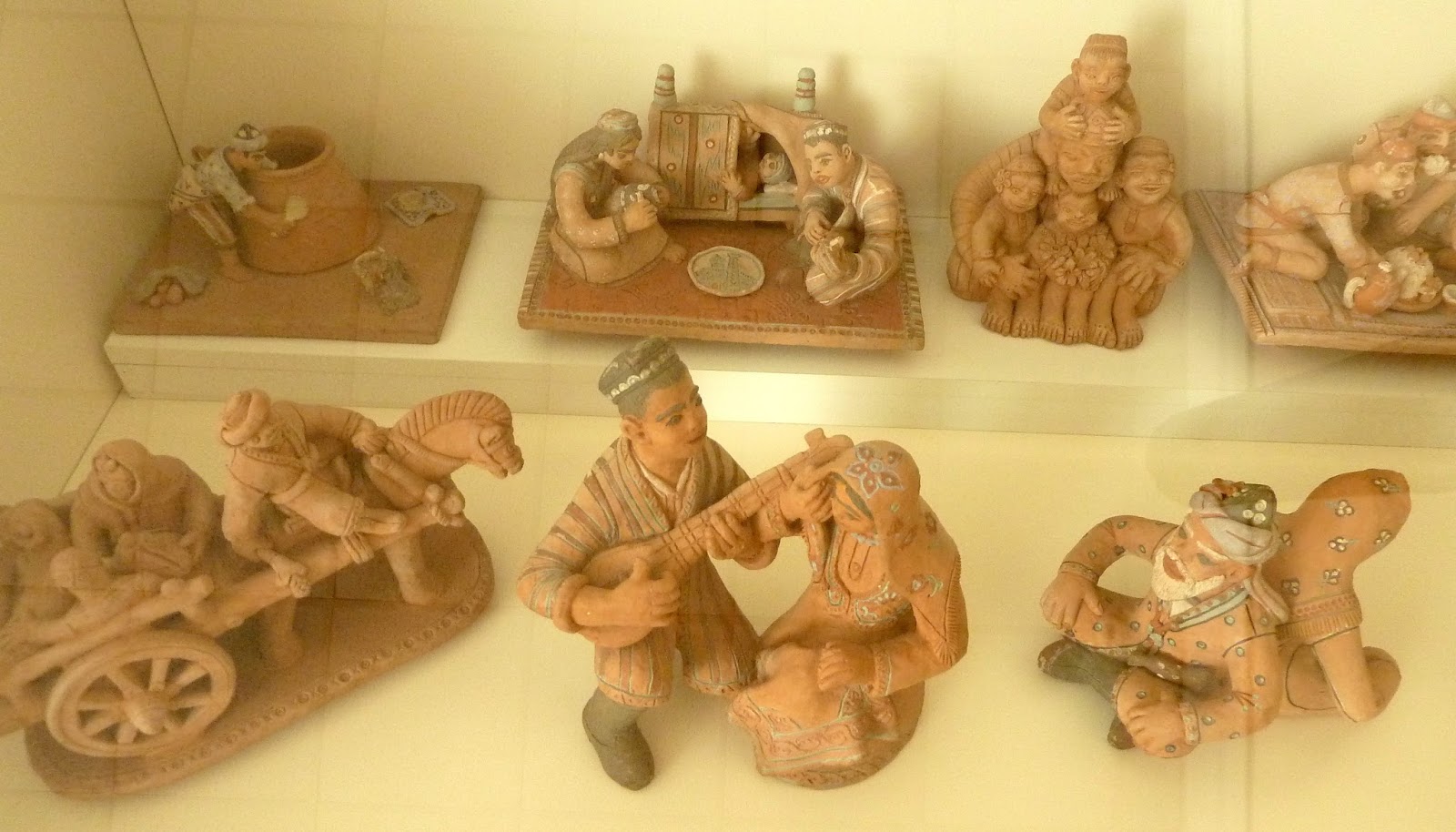
I am going to let the exhibits speak for themselves as they are just too beautiful. We were stunned by the quality of the work. 


There are different interpretations on its past history and what the building was used for.

Until the middle of 1930, the building housed a children's home. Later different organizations were opened, including the training center carving ganch, embossing. History of Museum of Applied Art of Uzbekistan dates back to 1927, when the first exhibition of artworks by artists of Uzbekistan was held here. Since July 1937 there used to be a museum of handicrafts when it was called the Museum of Handicrafts.  


In 1960, it was named "The permanent exhibition of applied art of Uzbekistan".
In 1997 the building was intended for the Ministry of culture of the Republic of Uzbekistan and received the status of “State Museum of Arts and Crafts”. 


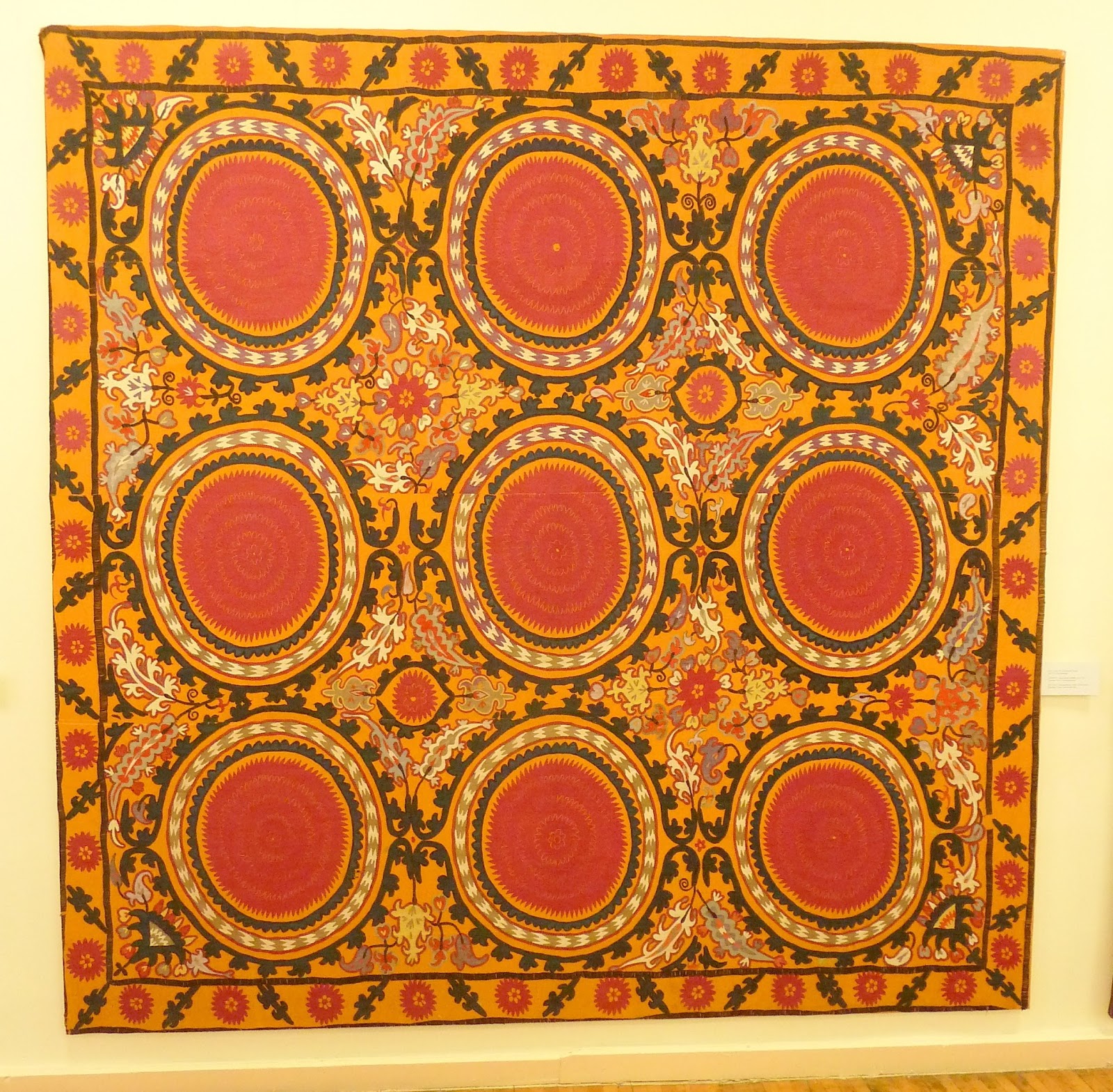
The Museum of Applied Art lists over 7,000 samples of applied arts: handmade embroidery, skull-caps (tyubeteyka), jewelry, carpets and other examples of craftsmanship of the beginning of the 19th century to present day.
The quality of the embroidery is mind blowing ! 


All the exhibits of Museum of Applied Art of Uzbekistan can be divided into three groups:
- Works of applied arts based on ancient traditions and relating to schools;
- Works created since the second half of the 19th century with due consideration of traditional craftsmen’s methods;

- Works of modern art, decorated with colorful ornaments on the basis of the modern arts development.

The Museum of Applied Art of Uzbekistan also has two gift shops, where you can buy a painting, graphics, porcelain, carpets, embroidery, fabrics, jewelry, coinage, varnished miniature by modern Uzbek masters.


Several hundreds of exhibits representing the diversity of arts and crafts of  the country: ceramic, metal, carving and painting on wood, artistic hand and machine embroidery, carpets, gold embroidery. This is the work of professional folk artisans who create original works of applied art.


Art Museum is a fine example of high skill architecture and decorative art of the end XIX century. The interior of the central hall of the museum (mehmonhona) differs with an architectural decoration. 

Its walls are decorated with ornamental carvings ganch and wooden ceiling covered with decorative painting in the technique kundal. 

Best examples from the collection of national decorative art, exhibited in 13 rooms of the museum are in harmony with the architectural complex of the building.


Text and photographs copyright of the author. No part of this article or photographs maybe transmitted or reproduced by any means, electronic, mechanical, photocopying or otherwise, without written permission. Do contact the author on email -- helpthesun@gmail.com

Chimgan Mts and Charvak reservoir - a Tashkent day trip - unforgettable


We had an extra day after our long cross country tour so we decided to go sightseeing – Farrukh of Advantours recommended this location and his arrangements, as usual, were perfect. Chimgan is the most popular ski resort of Uzbekistan, located 80 km from Tashkent on slopes of Chimgan Mountains which are the part of Chatkal range of western Tian-Shan.  
The Valley of Chimgan is at a height of 1200-1600 metres above sea level and is surrounded with mountains. Greater Chimgan Mountain at a height of 3309 metres is the main peak of the valley and towers above the entire valley.  


Chimgan Mountains include such beauty spots as Gulkam, Beldersay and others. 

In addition this district is the most ecological part of Uzbekistan as its part of Ugam-Chatkal National Park, covering various mountain landscapes of western Tian-Shan.
The drive takes 90 minutes over an excellent road from Tashkent and is approx 230 kms from centre of town return. For its beauty and health-improving properties Chimgan is called "Uzbek Switzerland". Slopes of mountains are covered with relict fir-tree woods. Mountains and hills are indented by mountain rivers, which people call "sai". There is the fresh and pure air with fragrance of numerous flowers and herbals - the word “Chimgan” or “Chim yon” is translated as “green grass”, “green valley”.                                                               


Photo stop at the Charvak water reservoir. Charvak is a huge artificial lake - a reservoir surrounded by green slopes of the mountains which are crowned with snow caps.The lake is formed by Charvak HPS dam. The lake is fed by the waters of three mountain rivers - Ugam, Chatkal and Pskem.
Many centuries ago this man-made sea was flooded. Traces of ancient settlements, fortresses, burial mounds, prehistoric man, etc can be still found here. In total, more than 150 monuments of ancient culture have been found here. In ancient times, the roads that connected Tashkent oasis with Kyrgyzstan and Ferghana run here.
Today Charvak lake is a favorite for summer holidays for the residents of Tashkent. The lake has become a resort. Around the lake, right on the mountain slopes there is a ring road along which various recreation areas and children's camps are located. They are located near the villages Bogustan, Brichmulla, Yangikurgan, Yusuphana etc.


There is a cable car going right up to the mountain. One system has steeper climb and takes 12 minutes; the other is 25 minutes and lesser incline. We took the second system based at Beldesay village, which was fun but scary as at the start and end, the car (actually a two seater chair); goes over a real high height and you are swinging away over the abyss! When we went, there were few tourists and I was surprised to see the many babies being taken on the chair car by their parents!! The ticket for the cable is 15,000 Som or just under $2/-. The top of the mountain gives an excellent scenic view of the whole countryside. 


The main inflow of tourists into this place is in winter and spring. In winter this area is most popular with admirers of winter sports: downhill skiing, toboggan, snowboarding, free-ride. The ski season starts in December and lasts until March. 

Spring is the time of alpinists, rock climbers, and sky surfers. In summer Chimgan has interesting itineraries along mountain landscapes, eg fly on paraglider, to ride horses. Besides it Chimgan Mountains attract tourists who love nature with its apple-tree and fir-tree forests, barberry and dog rose bushes, tumultuous rivers, beautiful lakes and waterfalls.  


After our mountain excursion, we stopped at the super restaurant Cinara. Incredible surroundings out in the open. Had an excellent lunch in the company of 400 – 700 year old mulberry trees and fresh country air. 


Good food too !! 


There are many high-rise buildings, hotels, cottages, cable rail road, network of shops, bars, restaurants and cafe and other recreation institutions such as recreation zones, sanatoriums, summer camps in this area. 


In the restaurant grounds, there are unique petroglyphs, rock carvings made by prehistoric people said to be over 1,000 years old but which today are not well kept due to negligence of the owners and being in the open without any security railing, 


Text and photographs copyright of the author. No part of this article or photographs maybe transmitted or reproduced by any means, electronic, mechanical, photocopying or otherwise, without written permission. Do contact the author on email -- helpthesun@gmail.com